Jakob von Uexküll's famous example. A tick's entire world consists of butyric acid; temperature. And hair texture; waiting years for these three signals to align.
Jakob Johann von Uexküll, Public domain, via Wikimedia Commons
The world of the tick
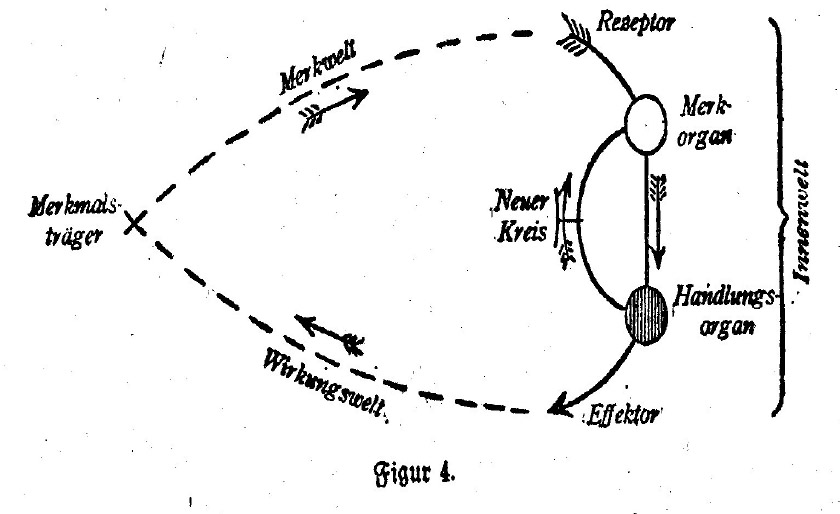
In 1926, the biologist Jakob von Uexküll founded the Institute for Environmental Research (Institut für Umweltforschung) at the University of Hamburg. It was here he formalized a concept that changed how we see the inner lives of other creatures: the Umwelt. The German word translates to "environment," but von Uexküll's idea was more specific. He proposed that every animal exists in its own unique perceptual world, a bubble of reality containing only what it can sense and what is meaningful to it. Everything else in the objective environment, or Umgebung, might as well not exist.
To explain this, von Uexküll used the example of a tick, likely the common castor bean tick, Ixodes ricinus. He described the tick's Umwelt as a world built from just three perceptual signals. The eyeless, deaf creature sits motionless on a blade of grass, sometimes for years, waiting. Most of the surrounding forest—sights, sounds, and smells—are absent from its reality. Its entire existence is tuned to a trio of specific cues that mean one thing: blood.
A life in three acts
The first signal to pierce the tick's sensory void is the smell of butyric acid. This chemical is present in the sweat of all mammals, and for the tick, it is the only smell. Upon detecting it, the tick lets go, dropping blindly from its perch.
The second signal is temperature. As it falls, the tick is sensitive to a specific warmth, around 37°C (98.6°F), the body temperature of a typical mammal. This thermal cue confirms it has landed on a potential host. If it lands on the cold ground, it simply climbs back up the nearest plant to wait again. The life cycle of an Ixodes ricinus tick typically takes three years, but much of that time is spent waiting.
The third and final signal is tactile. Once on the warm body, the tick uses its legs to sense the texture of hair. This triggers the final behavior: it burrows through the fur, sinks its mouthparts into the skin, and begins to feed. For several days it will drink the blood needed to molt to its next life stage or, if it's a fertilized female, to produce up to 2,000 eggs. For the tick, this three-part sequence is its world.
💡Fun Facts
Ticks perceive the world through a complex sensory pit on their forelegs called the Haller's organ, which detects humidity, temperature, and smells.
Jakob von Uexküll was an Estonian-born German biologist who founded the field of biosemiotics, the study of signs and communication in living organisms.
A tick's life cycle has four stages: egg, larva, nymph, and adult. Each stage requires a single blood meal to molt into the next.
Butyric acid, the chemical ticks are so sensitive to, is also what gives rancid butter and parmesan cheese their distinctive, pungent odors.
The University of Hamburg campus is generally accessible, but buildings have specific opening times. Check the university's official website for details on specific institutes or libraries.
Admission
Free to visit the campus grounds.
Accessibility
The campus is mostly flat with paved pathways, but accessibility may vary by building.