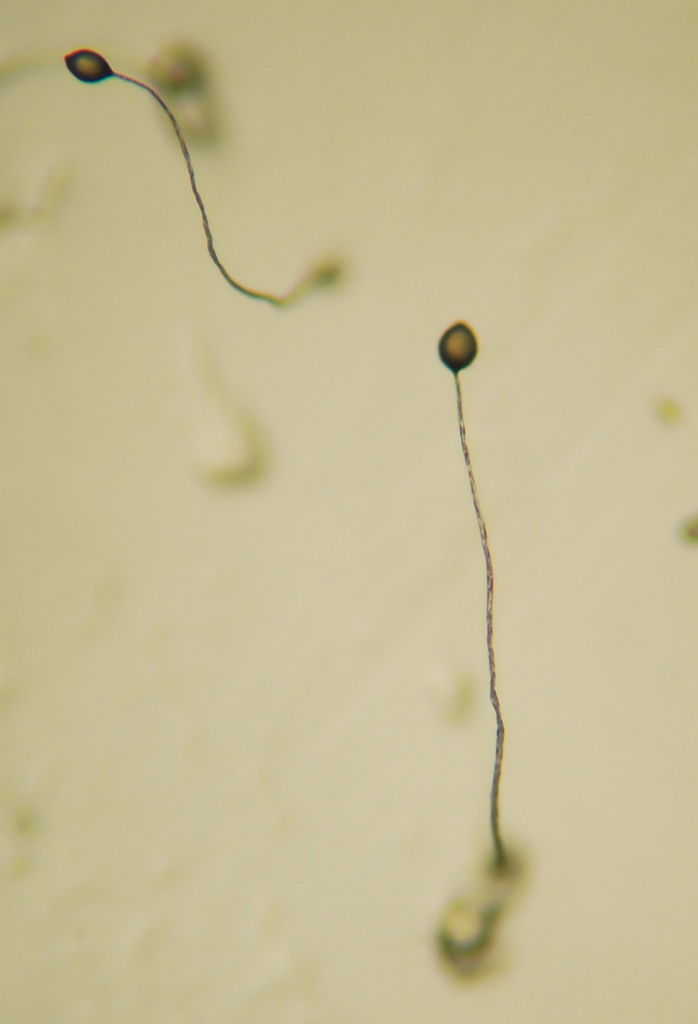
A life of solitude and society
In the damp leaf litter and soil of Massachusetts forests lives a remarkable organism, the social amoeba Dictyostelium discoideum. For most of its life, it exists as a solitary, single-celled amoeba, moving through the soil and consuming bacteria. These individual cells divide and multiply as long as their bacterial food source is plentiful. When the food runs out, however, a dramatic transformation begins. Starvation triggers a chemical distress signal, and the amoebas start to secrete pulses of cyclic AMP (cAMP). This signal draws the scattered cells together, and they stream toward a central point to form a multicellular aggregate.
This new collective, known as a pseudoplasmodium or "slug," can be composed of up to 100,000 individual cells. The resulting slug is a motile organism, typically 2-4 millimeters long, that crawls as a single unit toward light and heat, cues that guide it to the soil surface for optimal spore dispersal. The slug moves by producing a cellulose sheath, essentially laying down its own track through which the collective of cells glides. During this mobile phase, which can last for several days, the cells within the slug begin to differentiate. Roughly the front third of the slug is composed of prestalk cells, while the rear two-thirds are prespore cells.