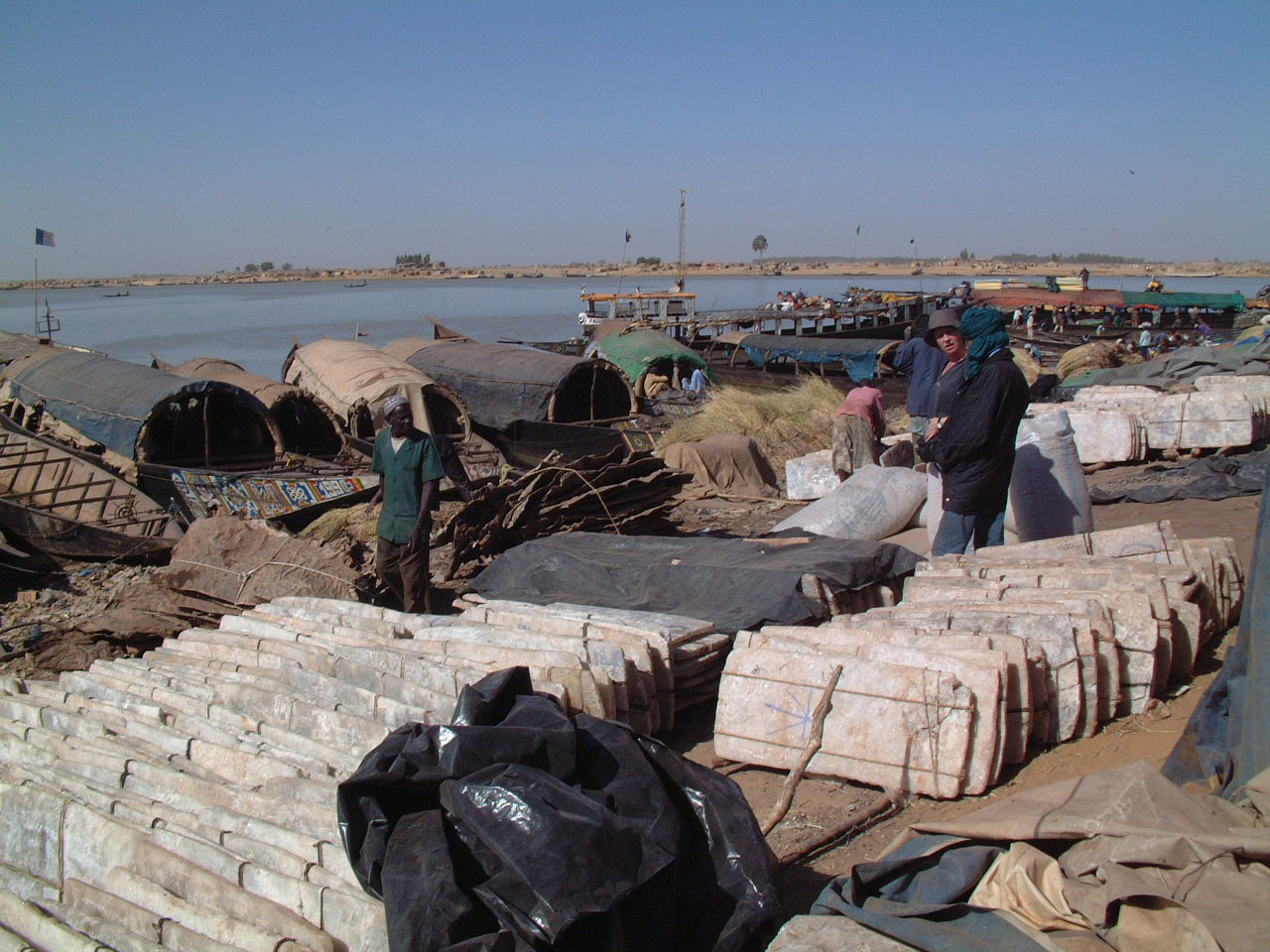
An economy built on salt
The Taoudeni Basin is a vast sedimentary formation in the Sahara Desert, the remnant of a prehistoric salt lake. For over a millennium, this desolate region was the center of a continental economy powered by one mineral: rock salt. West African empires like the Ghana, Mali, and Songhai controlled immense goldfields to the south but had almost no local sources of salt, a mineral important for human and animal life, especially in hot climates. This geographical imbalance created one of history's most focused examples of supply and demand.
Control of the northern salt mines at places like Taghaza, and later Taoudénit, meant control over the wealth of empires. Rock salt was mined from shallow pits, often dug 5 to 10 meters deep, where the mineral forms in large, stratified slabs. Miners, using basic hand tools, cut these slabs into standardized bars. While tales of salt being traded pound-for-pound with gold might be an exaggeration, the exchange rate was still exceptionally high, making the control of salt production and trade routes a primary geopolitical objective. The empires to the south taxed the salt caravans heavily, generating immense revenue. The earlier mining center, Taghaza, was so completely defined by its product that the 14th-century traveler Ibn Battuta noted its buildings were constructed from salt blocks, with roofs of camel skin.
The Azalai camel caravans
The logistical backbone of this economy was the Azalai, the semi-annual salt caravans undertaken by Tuareg traders. These caravans, sometimes involving thousands of camels, were feats of organization and endurance. A typical journey from Taoudénit to the trade hub of Timbuktu covered more than 664 kilometers (413 miles) and took about three weeks. The caravans departed twice a year, in November and March, to travel during the cooler parts of the year.
Each camel was loaded with up to four large salt slabs. The slabs could weigh between 20 and 40 kilograms each, meaning a single camel might carry a load exceeding 90 kilograms. The Tuareg guides who ran the caravans were expert desert navigators, essential for a journey with few water sources. The system was so organized that runners were sometimes sent ahead to oases to bring water back to the main caravan group. This trade network moved a commodity; it also ferried goods like textiles and glassware south, and facilitated the spread of ideas and Islam across the Sahara. While trucks have replaced much of the trade today, small-scale camel caravans still make the trek, continuing a practice that shaped the economic history of a continent.