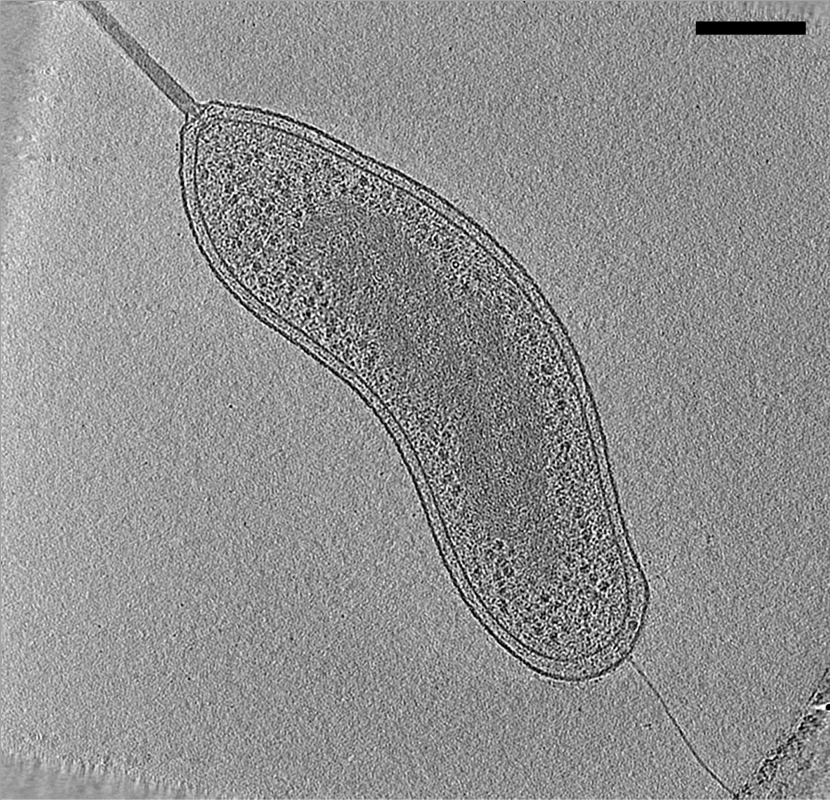
A bacterium that hunts other bacteria. It rams into prey, burrows inside, and consumes it from within before bursting out. Researchers investigate it as a living antibiotic against drug-resistant bacterial infections.
Eikosi, CC BY-SA 4.0, via Wikimedia Commons
A microscopic predator
In the dense bacterial ecosystems of soil, rivers, and sewage treatment plants lives Bdellovibrio bacteriovorus, a predatory bacterium that actively hunts other Gram-negative bacteria. This comma-shaped organism, measuring just 0.3–0.5 micrometers wide, is an efficient hunter. It propels itself through liquid with a single, powerful flagellum, reaching speeds of up to 160 micrometers per second. This is equivalent to traveling over 100 times its own body length every second.
B. bacteriovorus was discovered by accident in 1962 by scientists Heinz Stolp and Hans-Georg Starr, who were initially looking for viruses in soil samples. Instead, they found plaques of dead bacteria caused by this tiny predator. Its name shows its nature: bdella is Greek for "leech," and bacteriovorus is Latin for "bacteria-devouring". It thrives in environments with high concentrations of prey, making the wastewater systems of places like New York City ideal hunting grounds. It specifically targets Gram-negative bacteria, a group that includes common pathogens like E. coli and Salmonella.
The predatory cycle
The life cycle of B. bacteriovorus is a rapid and violent process that takes about three to four hours from start to finish. The cycle begins with the "attack phase," where the predator seeks out prey. Upon collision, it attaches to the prey's outer surface using its non-flagellated pole, which is covered in specialized filaments called type IV pili.
Once attached, B. bacteriovorus secretes a cocktail of hydrolytic enzymes to drill a hole through the prey's cell wall and outer membrane. It then squeezes into the periplasmic space—the area between the prey's inner and outer membranes. The entry pore is then resealed, trapping the predator inside and killing the host cell within minutes. The prey cell rounds into a structure called a bdelloplast, which is a nursery.
Inside the bdelloplast, the predator loses its flagellum and begins to consume the host's proteins, nucleic acids, and other internal components. It grows into a long filament, extending many times its original length. When the prey's resources are exhausted, this filament divides into multiple new progeny cells. Depending on the size of the prey, a single attack can yield an average of three to six new predators, which then grow flagella, lyse the dead host, and burst out to hunt for new targets.
A living antibiotic
The predatory nature of B. bacteriovorus interests scientists searching for new ways to combat antibiotic-resistant bacteria. Because it naturally preys on a wide range of Gram-negative pathogens, including multi-drug resistant strains of Klebsiella pneumoniae and Acinetobacter baumannii, it is being investigated as a "living antibiotic".
A significant advantage is its specificity. B. bacteriovorus does not harm mammalian cells, and it ignores Gram-positive bacteria, suggesting it could target specific infections without disrupting a person's beneficial microbiome. Studies in animal models have shown promising results. In zebrafish larvae, injections of the predator helped clear lethal infections of drug-resistant Shigella. In another study, it significantly reduced Salmonella populations in the guts of young chickens without causing adverse health effects. While research is ongoing, this bacterial hunter is a new strategy in the fight against superbugs.
💡Fun Facts
*Bdellovibrio* can swim at speeds over 100 times its body length per second, making it one of the fastest bacteria known.
The name *Bdellovibrio* comes from the Greek word "bdella," meaning leech, due to its parasitic, leech-like attachment to its prey.
The entire predatory cycle, from invading the prey to bursting out as new progeny, can be completed in just three to four hours.
A single *B. bacteriovorus* can produce three to six new predators from one *E. coli* cell, but up to 90 from larger, filamentous prey.