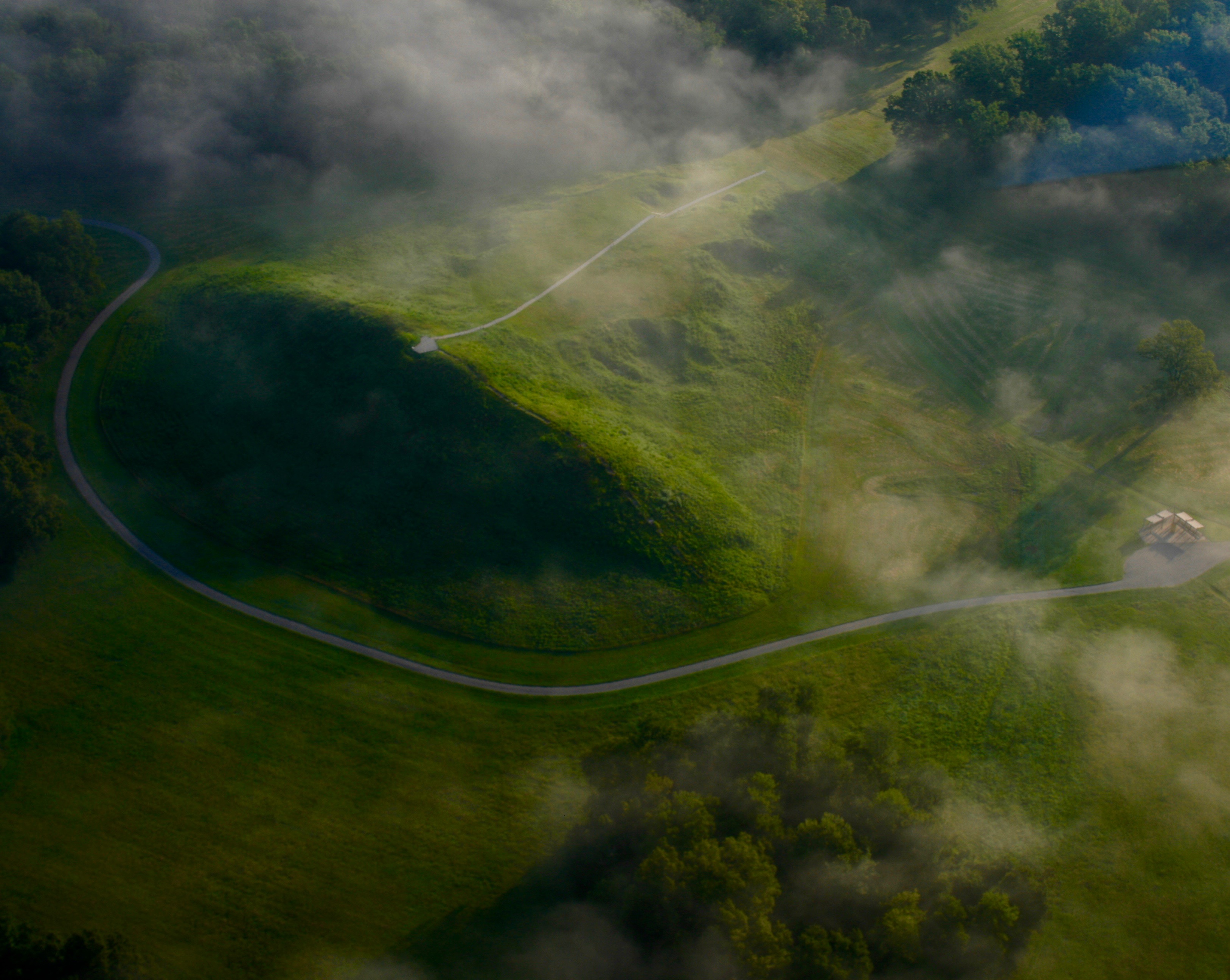
A Monument of Earth and Labor
Mound A, the central feature of the Poverty Point World Heritage Site, is a massive earthen structure shaped like a bird in flight. It stands 72 feet (22 meters) tall, with a wingspan of 660 feet (200 meters) and a length of 710 feet (215 meters). Radiocarbon dating indicates its construction took place between 1450 and 1250 BCE. The mound is composed of approximately 8.4 million cubic feet (238,000 cubic meters) of soil, making it the second-largest earthen mound by volume in eastern North America.
The construction was an immense undertaking, particularly for a pre-agricultural society. Laborers moved an estimated 53 million cubic feet of soil for the entire complex, carrying it in baskets that held about 50 pounds each. Archaeological studies suggest that the main structure of Mound A was built with remarkable speed, possibly in less than three months. This rapid, coordinated construction by a society of hunter-fisher-gatherers shows a high level of social organization. The site's builders, known as the Poverty Point culture, inhabited the area between 1700 and 1100 BCE.
A Society Built on Trade, Not Agriculture
The people of Poverty Point were hunter-fisher-gatherers, subsisting on the local resources of the Mississippi floodplain, including fish, deer, nuts, and fruits. Unlike later mound-building cultures, there is no evidence of domesticated crops at the site. What distinguished them was a vast and sophisticated trade network that spanned much of eastern North America.
Over 78 tons of rocks and minerals were imported from distant locations. These materials included soapstone from Alabama and Georgia, copper from the Great Lakes region, and various types of chert and flint from the Ohio and Tennessee River valleys. These imported stones were essential for creating tools, such as projectile points, and ceremonial objects. This extensive trade, likely conducted via river travel, supplied the raw materials that were absent in the local geography. The distribution of these valuable imported goods appears to be spread evenly throughout the site, rather than being concentrated in the hands of an elite class.
The purpose of the mounds and the larger complex is a subject of study. Some researchers propose it was a ceremonial or religious center, while others suggest it was a major trading hub. The aisles between the site's C-shaped ridges have led to theories of astronomical alignments with solstices and equinoxes, though this interpretation is still debated. The mounds themselves contain no human burials, a significant departure from many other ancient earthworks in the region.