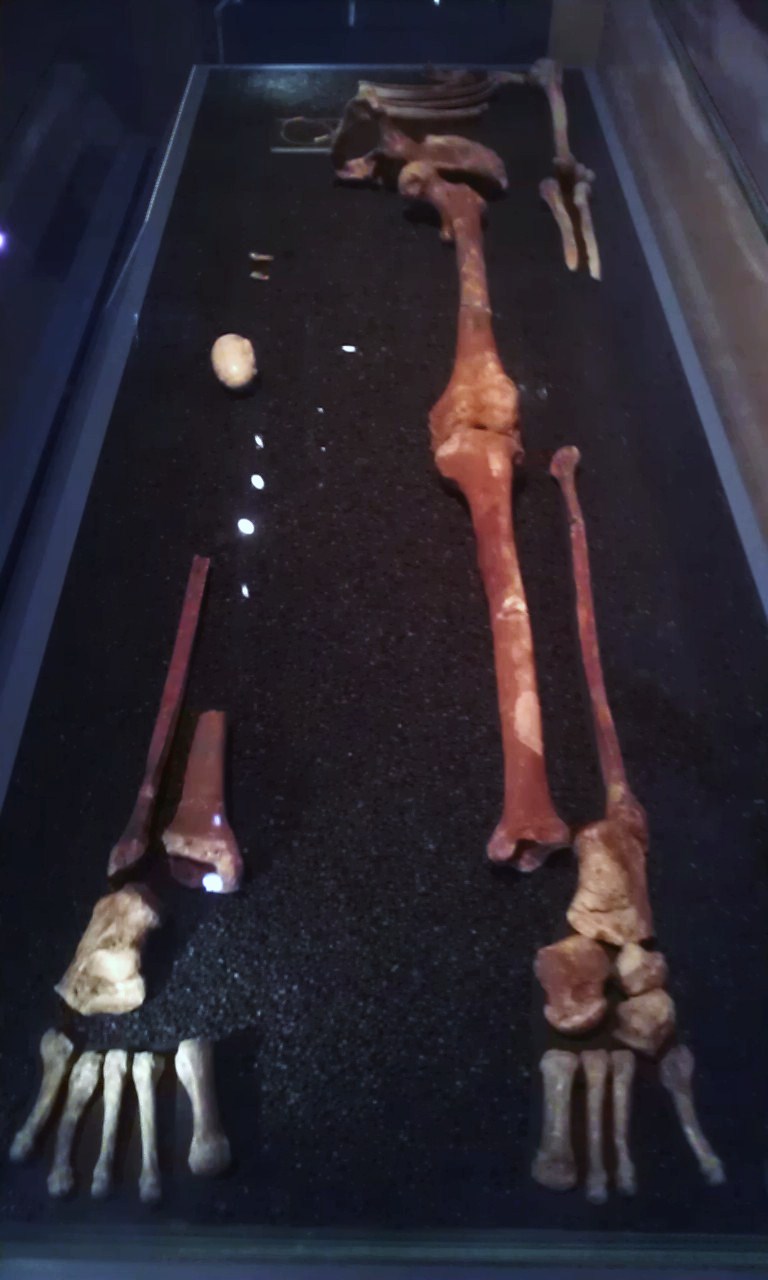
A 33,000-year-old skeleton stained red with ochre, buried with ivory jewelry - Europe's oldest known ceremonial burial. The 'Red Lady' was actually a young man. When he died, Wales was tundra connected to mainland Europe, and mammoths roamed nearby.
Ethan Doyle White, CC BY-SA 3.0, via Wikimedia Commons
An inconvenient discovery
In January 1823, Oxford University's first geology reader, Reverend William Buckland, entered Goat's Hole Cave on the Gower Peninsula to investigate finds of mammoth bones. Digging into the cave floor, he uncovered something unexpected: a human skeleton stained deep red, buried with ivory ornaments and seashells. Buckland, a creationist, believed no human remains could be older than the Biblical flood. He therefore concluded the skeleton was a Roman-era woman, perhaps a witch or prostitute, due to the red coloring and decorative items.
This interpretation was wrong on nearly every count. The discovery, which became known as the "Red Lady of Paviland," was not a woman and was far older than Roman Britain. Buckland's worldview prevented him from recognizing the skeleton's true age, despite it being found among the bones of extinct Ice Age animals. The collection of items buried with the body—including 40 perforated periwinkle shells, and rings and rods carved from mammoth tusk ivory—were grave goods. The burial was deliberate and ceremonial.
A clearer picture emerges
Modern science has corrected Buckland's initial assessment. Later analysis of the pelvic bone confirmed the skeleton belongs to a young man, who was about 5 feet 8 inches (173 cm) tall and died in his mid-twenties. The most important correction came from radiocarbon dating. A series of tests, with the most recent in 2008 and 2009, established the man lived approximately 33,000 to 34,000 years ago.
This places the burial in the Aurignacian period of the Upper Paleolithic, making it the oldest known ceremonial burial in Western Europe. The individual lived during a temporary warmer interval within the last major Ice Age. His world was vastly different from modern Wales. Sea levels were lower by as much as 250 feet (about 75 meters), and the Bristol Channel was a wide, grassy plain. The cave, now on a sea cliff, would have been around 70 miles (110 km) inland, overlooking a steppe-tundra environment populated by woolly mammoths, woolly rhinoceroses, and reindeer.
Isotope analysis of the man's bones shows details about his life. The chemical signatures show that between 15% and 20% of his diet came from marine sources, likely fish and shellfish. This suggests he was part of a group that was either semi-nomadic, moving between the coast and inland hunting grounds, or that his body was transported from the coast for burial in this specific location.
💡Fun Facts
William Buckland, the discoverer, was an eccentric who reportedly claimed to have eaten his way through the animal kingdom, including panthers, crocodiles, and mice on toast.
The skeleton is not located in Wales. It was taken to Oxford University by Buckland and remains in the collection of the Museum of Natural History.
A replica of the skeleton is on display at Swansea Museum in Wales.
The red ochre used to cover the body was not sourced locally, suggesting it was a valuable material transported from a distance for the burial rite.
Access to the cave is hazardous and not recommended for the public. It is located at the base of a limestone sea cliff and requires a dangerous scramble, possible only for about an hour on either side of low tide during certain parts of the month.