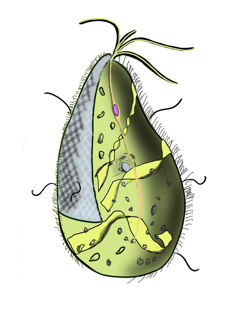
A composite creature
Inside the hindgut of Australia's giant northern termite, Mastotermes darwiniensis, lives a protist that is not a single organism but a walking community. Known as Mixotricha paradoxa, this single-celled creature is enormous for a microbe, reaching lengths of 500 micrometers (0.5 mm), making it visible to the naked eye. First described in 1933 by Australian biologist J.L. Sutherland, its name means "the paradoxical being with mixed-up hairs," a reference to an observation that would prove to be even stranger than he imagined.
M. paradoxa belongs to a group of protists called parabasalids, which mostly live inside other animals. Like its relatives, it has no mitochondria. Instead of generating its own energy through aerobic respiration, it has outsourced the job. Spherical endosymbiotic bacteria living inside its cytoplasm are its power plants, digesting wood particles the protist engulfs and producing energy for the entire collective. This arrangement is a necessity in the oxygen-free environment of the termite gut, where conventional mitochondria would be useless.
A community in motion
A feature of M. paradoxa is its method of movement. What Sutherland initially mistook for cilia are, in fact, about 250,000 spirochete bacteria of the species Treponema sp. attached to the protist's outer surface. These bacteria beat in coordinated waves, propelling the host cell through the termite's gut fluid. The protist itself has four of its own flagella, but these are weak and used for steering, much like a rudder.
This motility symbiosis is highly structured. The spirochetes do not attach directly to the main cell. Instead, the surface of M. paradoxa is covered in an ordered pattern of tiny brackets. A second type of bacteria, a rod-shaped species named Synergitannerella mixotrichae, also attaches to these brackets. Each spirochete is then anchored to a rod-bacterium.
The entire system is a nested series of dependencies. The termite cannot digest the cellulose in wood without protists like M. paradoxa. The protist cannot produce its own energy and cannot move without its bacterial partners. In total, a single M. paradoxa is a superorganism composed of at least five separate genomes: the protist nucleus, the internal energy-producing bacteria, and the three distinct types of bacteria on its surface. This makes it a living example of symbiogenesis, where distinct life forms merge to create a new, composite being.