An ancient rift awakens
Between December 1811 and February 1812, the central United States was struck by three of the most powerful earthquakes in the nation's recorded history. The main shocks occurred on December 16, 1811, January 23, 1812, and February 7, 1812. Modern estimates place their magnitudes between 7.2 and 8.2. The shaking was felt over an area of approximately 5 million square kilometers, with reports of church bells ringing in Boston and clocks stopping in Washington, D.C. The area of strong shaking was about 10 times larger than that of the 1906 San Francisco earthquake, due to the older and more rigid crust of the continental interior, which transmits seismic energy with great efficiency.
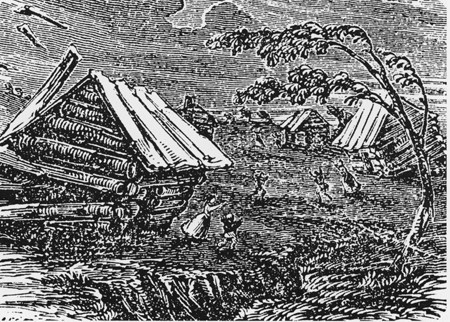
The effects on the landscape were immediate and severe. The ground rose and fell in visible waves, creating fissures and triggering massive landslides. An area of 5,000 square miles was visibly scarred by uplift, subsidence, and soil liquefaction. This last phenomenon, where saturated soil behaves like a liquid, caused huge jets of sand and water to erupt from the ground, creating features called "sand blows" that are still visible today. The February 7th quake, centered near the town of New Madrid, Missouri, caused sections of the Mississippi River's banks to collapse and uplifted the riverbed, forcing the water to flow backward for a period of several hours. This event also dammed the Reelfoot River and flooded the surrounding forest, creating the 18,000-acre Reelfoot Lake in Tennessee.
A hidden fault zone
These massive intraplate earthquakes occurred far from any tectonic plate boundary, a geologic puzzle for scientists for more than a century. The source is the New Madrid Seismic Zone (NMSZ), a 150-mile-long network of faults buried deep beneath the Mississippi River Valley. These faults are part of the Reelfoot Rift, a failed continental rift system that formed around 600 million years ago when the supercontinent Rodinia began to break apart. This zone of weakness in the North American Plate is being reactivated by modern east-west compressional stress from plate motions.
The NMSZ is still highly active, producing around 200 small earthquakes each year, though most are too faint to be felt. Geologic evidence from paleoseismology shows that large earthquake sequences similar to the 1811-1812 event have occurred before, in approximately 1450 AD and 900 AD, suggesting a recurrence interval of about 500 years. Based on this, the U.S. Geological Survey estimates there is a 7-10% probability of a magnitude 7.0 or greater earthquake occurring in the next 50 years, and a 25-40% chance of a magnitude 6.0 or greater quake in the same timeframe. A repeat of the 1811-1812 events today would cause extensive damage across parts of at least seven states.