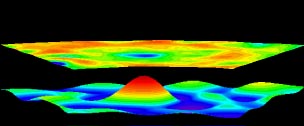
A Pull Towards the Unexpected
The Moon is the most gravitationally "lumpy" major body in the Solar System. Its largest mass concentrations, or "mascons," can alter the local gravity enough to make a plumb bob hang a third of a degree off vertical. These invisible regions of high gravity were first discovered in 1968 by Paul M. Muller and William L. Sjogren at NASA's Jet Propulsion Laboratory. They noticed that the pre-Apollo Lunar Orbiter spacecraft would dip and accelerate as they passed over certain areas, revealing an unexpectedly uneven gravitational field. This phenomenon posed a significant navigational hazard; early orbital calculations were off by factors of 100, and it was quickly understood that uncorrected low lunar orbits are unstable, leading to spacecraft crashing into the surface within months or even weeks. The subsatellite released by Apollo 16, for instance, was expected to orbit for a year and a half but crashed after only 35 days. This gravitational "lumpiness" had to be accounted for to ensure the precise landings of subsequent Apollo missions, starting with Apollo 12.
The mascons are primarily located under the large, circular impact basins on the Moon's near side, such as Mare Imbrium, Mare Serenitatis, and Mare Crisium. These basins are themselves topographic depressions, where a negative gravity anomaly would be expected. The presence of a strong positive anomaly indicates a significant excess of mass lurking beneath the surface. The largest mascon, under Mare Imbrium, has an anomalous mass of about 10^21 grams. This is equivalent to an additional layer of basalt rock 3 kilometers thick. These dense regions are powerful enough to increase the local force of gravity by half a percent.