A world within a world
Deep beneath your feet, resting on the molten outer core, are two structures larger than any continent on the surface. These are the Large Low-Velocity Provinces (LLVPs), massive thermochemical piles that disrupt the flow of heat and material from the planet's interior. One, named "Jason," sits under the Pacific Ocean; the other, "Tuzo," is located beneath Africa and the Atlantic. Jason is about 3,000 kilometers (1,900 miles) across, while both structures can rise up to 1,000 kilometers from the core-mantle boundary—more than 100 times the height of Mount Everest. Together, they account for about 6% of the Earth's total volume.
Scientists discovered these features not by digging, but by listening. Using seismic tomography, which analyzes how earthquake waves travel through the planet, they noticed two vast areas where shear waves slow down by 1-3%. This slowdown indicates that the LLVPs are different from the surrounding mantle. Their boundaries are surprisingly sharp, suggesting they are hotter zones but are made of a different chemical composition. Models suggest they are between 2.0% and 3.5% denser than the surrounding rock.
Remnants of a planetary collision
The source of these deep-earth continents is a major geological question. One hypothesis is that they are graveyards of subducted oceanic crust, dense slabs of seafloor that have been pushed down into the mantle over hundreds of millions of years and have accumulated at the bottom. The Pacific LLVP, Jason, seems to be continuously fed new material from the active "Ring of Fire" subduction zones that surround it.
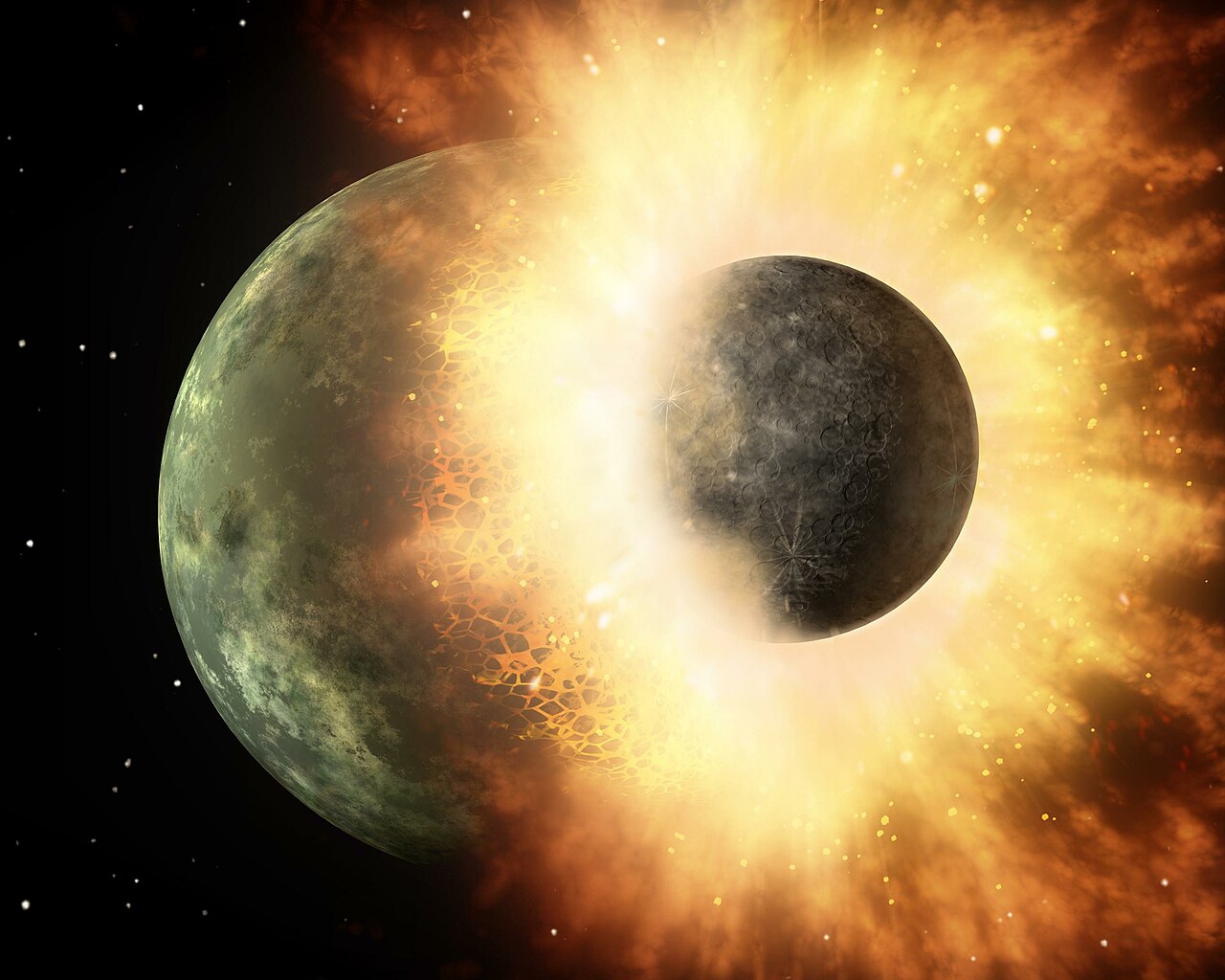
A more dramatic theory connects the LLVPs to the formation of the Moon. About 4.5 billion years ago, a Mars-sized protoplanet named Theia is thought to have collided with the early Earth. This giant impact blasted debris into orbit that coalesced to form the Moon. According to this hypothesis, large fragments of Theia's iron-rich mantle plunged deep into Earth, eventually settling on the core to form the LLVPs. If true, these hidden structures are the remains of an ancient alien world buried inside our own.
The LLVPs are not static. They appear to influence processes on the surface. Mantle plumes—upwellings of hot rock—preferentially rise from the sharp edges of the LLVPs. These plumes feed volcanic hotspots like Hawaii, Iceland, and the Galapagos, and are responsible for Large Igneous Provinces (LIPs), some of the most massive volcanic outpourings in Earth's history. By anchoring mantle convection, the LLVPs may have even dictated how supercontinents like Pangea broke apart and where modern continents are today.