The anatomy of a collapse
Around 52,000 years ago, the massive ancestral Maninjau volcano experienced a catastrophic failure. A large portion of the mountain's flank collapsed, transforming into a fast-moving debris avalanche. This enormous mass of rock and volcanic debris traveled remarkable distances, with deposits found up to 50 km to the east and 75 km to the southeast. The total volume of erupted material is estimated to be between 220 and 250 cubic kilometers, blanketing an area of 8,500 square kilometers.
This event was not a landslide. It was a debris avalanche, a turbulent, gravity-driven current of rock fragments, ash, and other debris. The deposit left behind is characterized by a distinctive landscape feature: hummocks. These are small, conical mounds and hills that dot the terrain. Each hummock represents a relatively intact piece of the original volcano that was carried along by the avalanche. The size of these blocks often depends on their distance from the source; the largest ones are found closer to the caldera. The landform created by the Maninjau event is an example of a volcanic sector collapse, leaving behind a clear amphitheater-shaped scar at the source and the sprawling, hummocky terrain downhill.
Megablocks and the aftermath
The most striking features of the Maninjau debris avalanche deposit are the colossal blocks embedded within it. These megablocks, which form the core of the largest hummocks, can be hundreds of meters in diameter. They are fragments of the original stratovolcano's internal structure, preserving the layering of old lava flows and pyroclastic deposits, even after being transported many kilometers. The material consists largely of rhyolitic and andesitic pumiceous tuff.
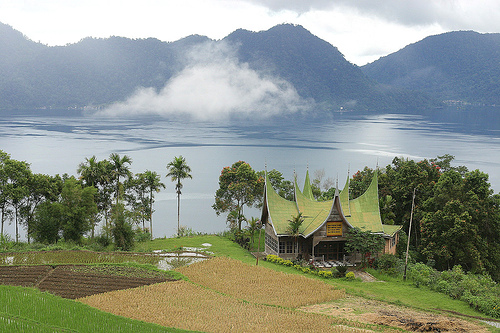
The collapse that triggered the avalanche also created the vast Maninjau caldera. This depression, measuring approximately 20 km long and 8 km wide, is the direct result of the volcano's structural failure. Today, this caldera is filled by Lake Maninjau, a body of water with a surface area of nearly 100 square kilometers and a maximum depth of 165 meters. The lake sits at an elevation of 459 meters, its serene waters concealing the evidence of a violent geological past. The steep walls surrounding the lake are the remnants of the ancient volcano, shows the immense scale of the collapse. The deposits from this single event are, in some places, over 200 meters thick.