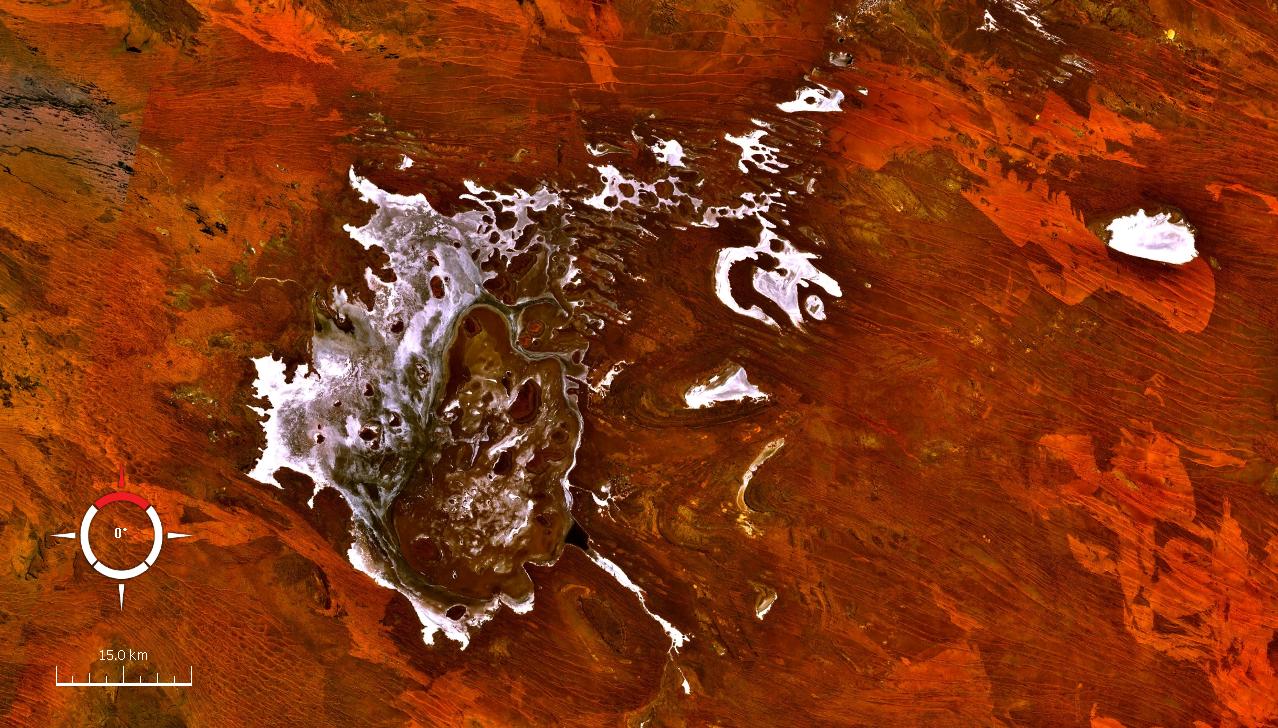
An Evaporating Chemical Basin
Kumpupintil, also known as Lake Disappointment, is a massive ephemeral salt lake in the Little Sandy Desert of Western Australia. Spanning roughly 33,000 hectares, it sits in an endorheic basin, meaning water flows in but has no outlet to the sea. The lake bed sits at an elevation of 325 meters above sea level and is the terminal point for a vast drainage area. Creeks in the region flow inland, carrying dissolved minerals from the surrounding ancient geology. Under the intense desert sun, the water evaporates, leaving behind a super-saturated brine and a thick crust of salt. This process concentrates dissolved solids, creating a chemical composition distinct from any ocean.
The lake and its unique properties are the focus of mineral exploration. One company, Reward Minerals, proposed a project to extract brine from the lakebed sediments to produce sulfate of potash (SOP), a premium fertilizer. The plan involved pumping approximately 60 gigalitres of brine per year into a series of solar evaporation ponds built directly on the lake's surface. Drilling programs confirmed that the lakebed sediments, which average 4.1 meters in thickness, are saturated with this valuable brine.
A Brine with High Potassium
The brine chemistry of Kumpupintil is unique. While seawater is dominated by sodium chloride, the brine here has high concentrations of potassium. This makes it a target for producing sulfate of potash, a critical component of fertilizers for which Australia has historically relied on imports. The proposed extraction process relies entirely on solar evaporation, a method that uses the sun's energy to separate the desired salts from the water.
The chemical makeup of the brine is unusual. Compared to evaporated seawater, the magnesium chloride content in Kumpupintil's brine is much lower. This specific ionic composition influences the types of minerals that crystallize as the water evaporates. The project planned to disturb over 7,000 hectares, mostly on the lake surface itself, for the ponds and processing facilities. Non-target salts, primarily sodium chloride, would be stockpiled on the playa. While the project has since been halted, the lake is a significant potential resource of strategic minerals concentrated by natural geological and climatic processes.