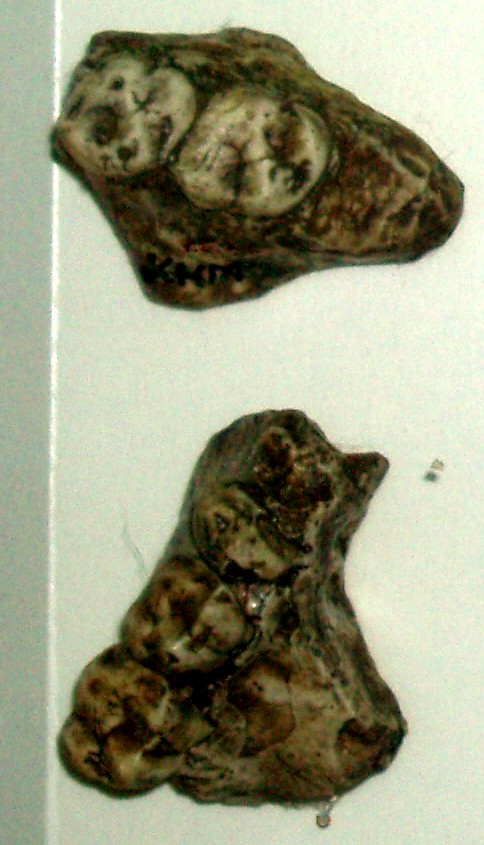
14-million-year-old teeth showing thick enamel. The first adaptation for hard foods that would later characterize human ancestors.
Ghedoghedo, CC BY-SA 3.0, via Wikimedia Commons
An Ape with a New Diet
In 1961, the paleoanthropologist Louis Leakey discovered fragments of an upper jaw and teeth at Fort Ternan, a site in western Kenya. The fossils belonged to a previously unknown species of extinct ape which Leakey named Kenyapithecus wickeri. Radiometric dating of the volcanic layers surrounding the fossils established their age at approximately 14 million years old, placing them in the Middle Miocene epoch. This discovery showed a period of ape evolution that was, until then, poorly understood.
The environment of Fort Ternan 14 million years ago was not a dense forest, but a more open woodland or grassy woodland. This habitat shift is reflected in the animal fossils found alongside Kenyapithecus, which include ancient relatives of antelopes and giraffes adapted to more open country. The fossils themselves are preserved within paleosols—ancient soils formed from weathered volcanic tuff. The species Kenyapithecus wickeri is known from a small collection of fossils, including jaw fragments, a distal humerus, and about a dozen isolated teeth, all housed at the National Museums of Kenya.
A Bite into the Future
The teeth of Kenyapithecus wickeri are its most telling feature. Unlike earlier apes such as Proconsul, which had thin enamel for eating soft fruits, Kenyapithecus had molars and premolars with a thick layer of enamel. This dental adaptation reflects a changing diet. The thick enamel provided durability for processing tough or hard foods, such as nuts, seeds, and coarse vegetation found in its woodland environment. This dietary shift is different from the fruit-based diets of its arboreal predecessors.
The robust jaw and thickly enameled teeth of Kenyapithecus show a convergence with features seen millions of years later in early human ancestors like Australopithecus. Leakey initially proposed that Kenyapithecus was a direct human ancestor because of these modern-looking dental traits. While its exact position on the family tree is still debated by scientists, the dental adaptations of Kenyapithecus represent a successful experiment in exploiting new food sources on the ground. This ability to consume a wider variety of foods was a foundational step that would reappear in the lineage leading to humans.
💡Fun Facts
The species name *wickeri* honors Fred Wicker, the owner of the farm where Leakey first found the fossils.
The volcanic minerals in the soil at Fort Ternan, specifically sanidine crystals, allowed for precise Potassium-Argon dating of the site.
Fossil evidence from Fort Ternan shows that some of the earliest forms of gazelles lived in the same environment as *Kenyapithecus*.
The discovery of *Kenyapithecus* helped solidify Africa, and Kenya in particular, as a center for the origins of the great ape and human clade.
The Fort Ternan Prehistoric Site is managed by the National Museums of Kenya. Hours are not consistently posted; contacting the National Museum in Nairobi or the regional office in Kisumu before visiting is recommended.
Admission
Fees may apply. It is best to confirm with the National Museums of Kenya.
Accessibility
The site is in a rural area with rugged, uneven terrain. There are basic facilities, but reports from 2020 indicate the site lacks consistent electricity and water.