The Staff God and the Monolith
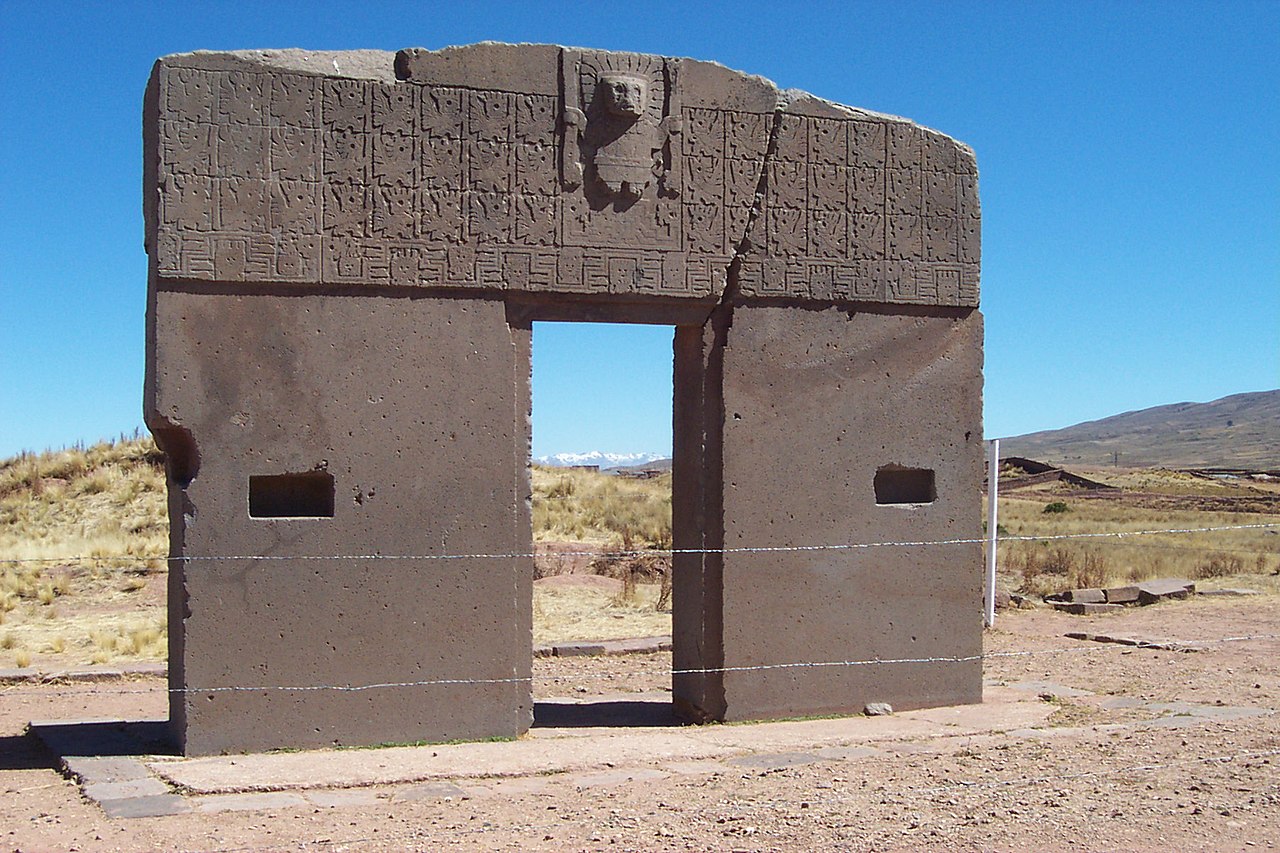
The Gate of the Sun is a single, 10-ton block of grey andesite stone, measuring approximately 3 meters (9.8 feet) high and 4 meters (13 feet) wide. European explorers rediscovered it in the mid-19th century, lying horizontally with a large crack through it. While it now stands upright within the Kalasasaya temple complex, this is not believed to be its original location. The stone was quarried and transported from a site about 90 kilometers away, a feat that would have required moving it across Lake Titicaca on reed rafts and then overland.
Dominating the gate's upper frieze is a central figure identified by archaeologists as the Staff God. This deity, a forerunner to the Inca creator god Viracocha, is shown in a frontal pose, holding a staff in each hand. The staffs may represent spear-throwers or thunder and lightning. The god's head is surrounded by 24 linear rays, and carvings that appear to be tears descend from its eyes, giving it the alternative name, the "Weeping God". This central figure is the center of the entire composition, carved with a depth and detail that sets it apart from the surrounding figures.
The Winged Attendants and the Calendar
Flanking the Staff God are 48 smaller, winged figures set in three rows. These figures, sometimes called "chasquis" or messengers, are depicted in profile, running inward toward the central deity. The assembly is divided into 32 figures with human faces and 16 with condor heads. The iconography of these "attendants" and the central god spread throughout the Andean region, appearing on ceramics and textiles of the later Wari culture.
The arrangement of the figures has led to theories that the gate functions as a sophisticated calendar. One interpretation suggests the carvings possess astronomical significance, marking solstices and equinoxes. Researcher Arthur Posnansky proposed in the 20th century that the gate represents a solar calendar, though his specific chronology has been largely refuted by modern dating methods. Radiocarbon dating places the main construction period of Tiwanaku's monumental structures between approximately 700 and 900 CE. The Tiwanaku civilization, which flourished at an altitude of over 3,800 meters (12,500 feet), mysteriously collapsed around 1000-1100 CE, leaving the gate's precise meaning undeciphered.