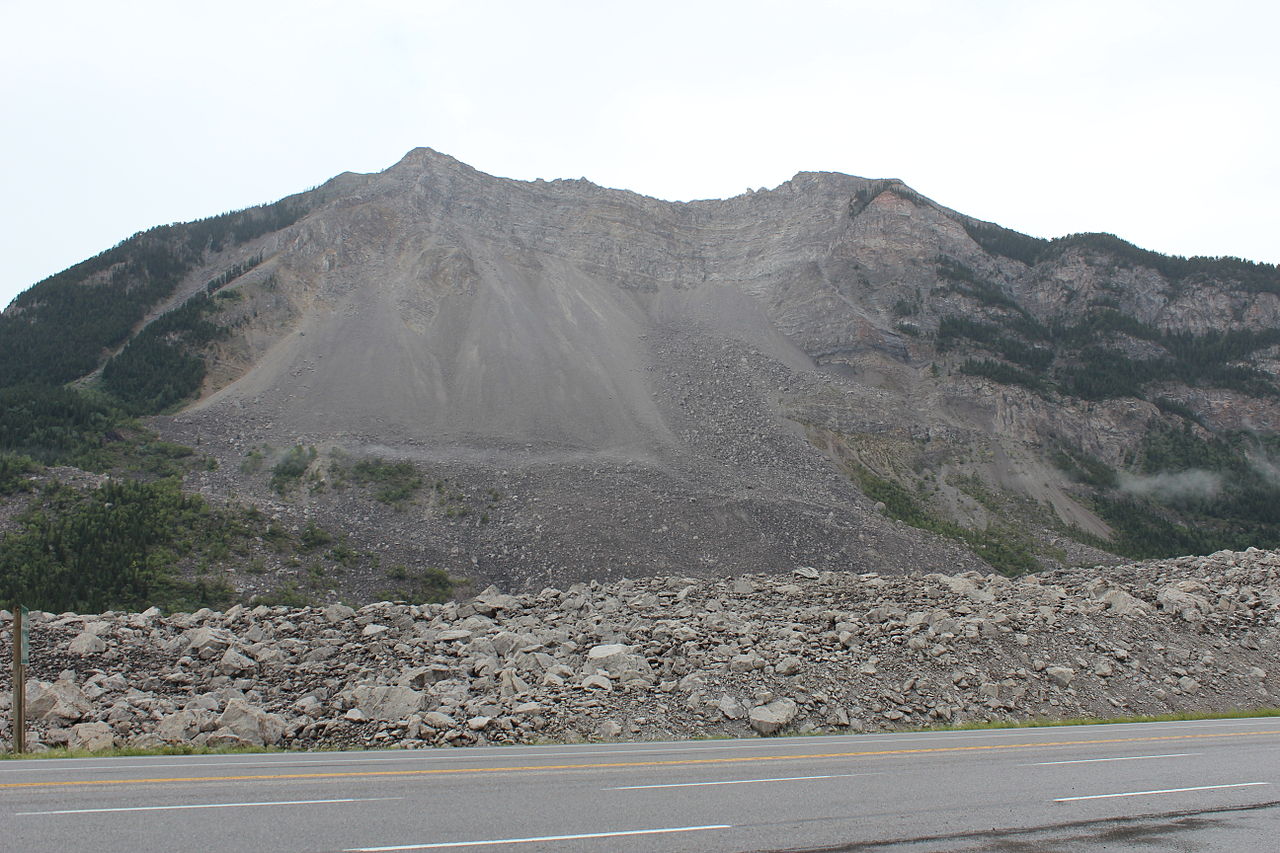
Anatomy of a collapse
The Frank Slide was not random; it was the result of Turtle Mountain's precarious geological structure. The mountain is an anticline, a formation where rock layers that were once flat have been pushed up into an arch. This process left the layers of Paleozoic limestone on the summit steeply angled, resting on top of weaker layers of sandstone and shale. A major fault, the Turtle Mountain Thrust Fault, further weakened the mountain's internal structure.
Over millennia, erosion and glaciation carved away the softer rock at the mountain's base, creating a significant overhang. Large fissures, some over 30 meters deep, opened along the summit, allowing water to penetrate deep inside. The freeze-thaw cycle of this water acted like a wedge, progressively forcing the cracks wider. Coal mining operations, which began in 1901, are considered a contributing factor. Miners excavated large chambers within a nearly vertical coal seam at the mountain's base, potentially removing support for the unstable rock above. The local Blackfoot and Ktunaxa people had long recognized the mountain's instability, calling it "the mountain that moves" in their oral traditions.
A catastrophe in motion
On April 29, 1903, at 4:10 AM, a slab of limestone 1 kilometer wide, 425 meters high, and 150 meters thick detached from the summit. The mass of rock, weighing an estimated 110 million tonnes, traveled at speeds up to 120 km/h. It crossed the 3-kilometer-wide valley floor in about 100 seconds, burying a section of the town of Frank, the Canadian Pacific Railway line, and the coal mine's surface buildings. The sound was heard over 200 kilometers away.
The debris field covered three square kilometers with rock to an average depth of 14 meters, though in some places it is 45 meters deep. Of the approximately 100 people in the direct path of the slide, an estimated 70 to 90 were killed, though only 12 bodies were recovered immediately after. Another six were found in 1922 by a road crew. The rest remain buried. Seventeen miners who were underground at the time of the slide were trapped. They managed to dig their way out through a coal seam after 13 hours. Despite the devastation, the railway was repaired and operational within three weeks, and the mine reopened in about a month.