The pressure paradox
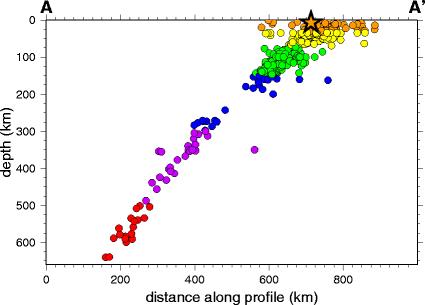
Deep-focus earthquakes are a geological contradiction. They occur at depths greater than 300 kilometers, where ambient pressures and temperatures are so extreme that rock should deform like clay, not shatter. Yet, the planet trembles with these deep ruptures, most actively in the Tonga-Kermadec subduction zone. Here, the Pacific Plate dives westward beneath the Australian Plate in a process called subduction. This region experiences the fastest plate velocity on Earth, with the northern part of the trench moving at up to 24 centimeters per year.
This rapid descent drags the cold, dense oceanic crust deep into the Earth's mantle. The inclined plane of seismic activity that marks this descent is known as a Wadati-Benioff zone, named after seismologists Kiyoo Wadati and Hugo Benioff who independently discovered it. Wadati first proved the existence of earthquakes below 300 kilometers in the 1920s, challenging the scientific consensus of the time. The Tonga Trench contains the most active deep-focus faulting zone in the world, with earthquakes recorded at depths of over 735 kilometers. Due to their extreme depth, these quakes rarely cause surface damage or tsunamis, but their seismic waves show data about the Earth's interior structure. A powerful magnitude 8.2 deep-focus earthquake struck the region in August 2018 at a depth of 600 kilometers.
A mineralogical suspect
The leading explanation for how rocks can break under such immense pressure involves a sudden change in their mineral structure. Much of the Earth's upper mantle consists of a green mineral called olivine. As the cold subducting slab carries olivine deeper, the intense pressure forces its atoms to rearrange into a denser crystal structure. At around 410 kilometers, olivine transforms into wadsleyite. Deeper still, it becomes ringwoodite, and finally, near 680 kilometers, it breaks down into bridgmanite and periclase.
Ordinarily, this transformation is slow. In the cold, fast-moving core of the subducting Pacific Plate, however, olivine can be carried to depths where it is far outside its stability zone, becoming "metastable." Scientists propose that this metastable olivine can suddenly collapse into its denser form along shear planes. This rapid, fault-like collapse, sometimes called "transformational faulting," releases enormous amounts of energy, generating an earthquake. Laboratory experiments have replicated this process, showing that the transformation from olivine to its denser forms can destabilize the surrounding rock and trigger faulting under deep-mantle conditions. These experiments produced miniature earthquakes, supporting the theory that mineral physics is the cause of the world's deepest seismic events.