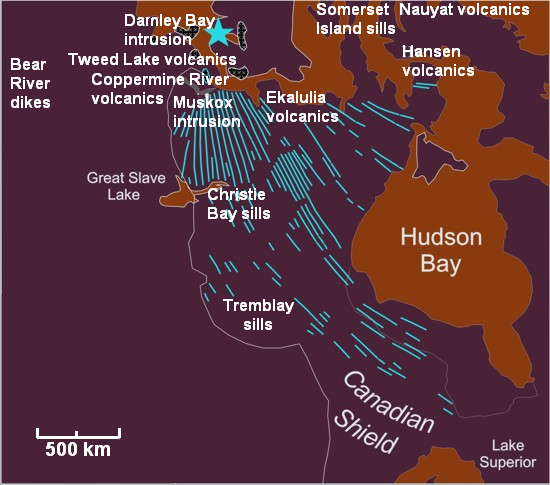
A planet-scale eruption
Roughly 1,267 million years ago, during the Mesoproterozoic Era, a mantle plume began to push against the crust under the supercontinent Rodinia. This hotspot led to a colossal outpouring of basaltic lava, creating one of the largest and best-preserved continental flood basalt regions on the planet. This event, known as the Mackenzie Large Igneous Province, covers an immense area of what is now the northwestern Canadian Shield. The Coppermine River Volcanic Sequence is a major part of this province.
The eruption produced at least 500,000 cubic kilometers of lava, forming a volcanic plateau that originally spanned about 170,000 square kilometers. The sequence consists of approximately 150 individual lava flows stacked one on top of another. These tholeiitic basalt flows vary in thickness from 10 to 25 meters each, creating a total vertical thickness that reaches between 2,000 and 3,500 meters in some areas. The entire volcanic event happened in a geologically short span of less than five million years. The vast Mackenzie dike swarm, a series of rock channels that fed the lava to the surface, radiates from a focal point near Victoria Island and is directly associated with these flows.