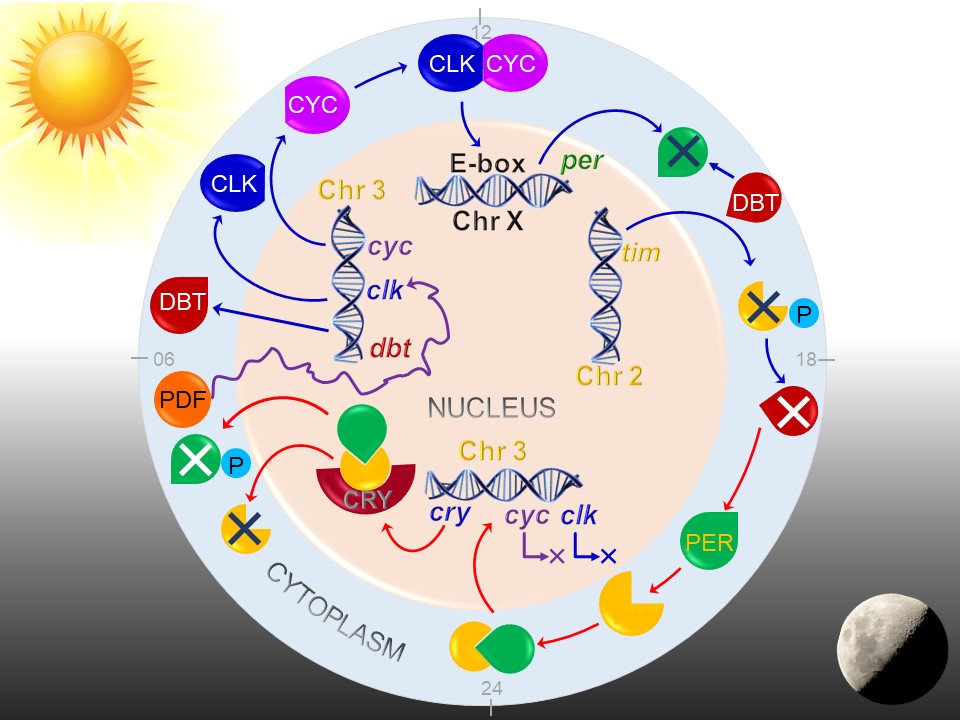
A clockwork of genes
On the campus of Brandeis University, researchers Jeffrey C. Hall and Michael Rosbash performed work that would earn them the 2017 Nobel Prize in Physiology or Medicine. Their subject was the humble fruit fly, Drosophila melanogaster, and their focus was a single gene that explains how animals, plants, and humans adapt their biological rhythms to the Earth's rotation. This internal timekeeper, the circadian clock, regulates sleep, hormone levels, metabolism, and body temperature.
In 1984, the teams of Hall and Rosbash at Brandeis, along with Michael W. Young at Rockefeller University, successfully isolated the gene called period (per). They demonstrated that this gene directs the production of a protein, named PER, which accumulates in the cell's cytoplasm during the night. As the night progresses, PER levels rise. The core of the clock is a negative feedback loop: once PER reaches a high enough concentration, it enters the cell's nucleus and blocks the activity of its own period gene.
This action stops the production of new PER protein. During the day, the accumulated PER protein is gradually degraded. As PER levels fall, the brake on the period gene is released, and the gene switches back on, restarting the approximate 24-hour cycle. This entire mechanism—production, accumulation, and self-inhibition—is a self-sustaining molecular oscillator that keeps time inside the cell.
The partners in time
The initial discovery of the period gene and its feedback loop was the first step. A complete picture required identifying the other gears in the molecular clockwork. In 1994, Michael Young's lab discovered a second critical clock gene, which they named timeless (tim). The timeless gene produces the TIM protein, which acts as a partner to PER.
Researchers found that the TIM protein must bind to the PER protein for the clock to function correctly. This PER/TIM complex is the version of the protein stable enough to enter the cell nucleus and inhibit the period gene. Without TIM, the PER protein is targeted for degradation and cannot accumulate to sufficient levels to enter the nucleus and complete the feedback loop. Light is involved in this process; exposure to light activates a protein that degrades TIM, which in turn allows the clock to reset and synchronize with the external day-night cycle.
Another gene, discovered by Young's team and named doubletime (dbt), fine-tunes the length of the cycle. The DBT protein phosphorylates the PER protein—it attaches a phosphate group—which signals that PER should be degraded. This controls the rate at which PER accumulates, ensuring the entire cycle takes approximately 24 hours to complete. These same genetic principles govern the biological clocks in the cells of most multicellular organisms, including humans.