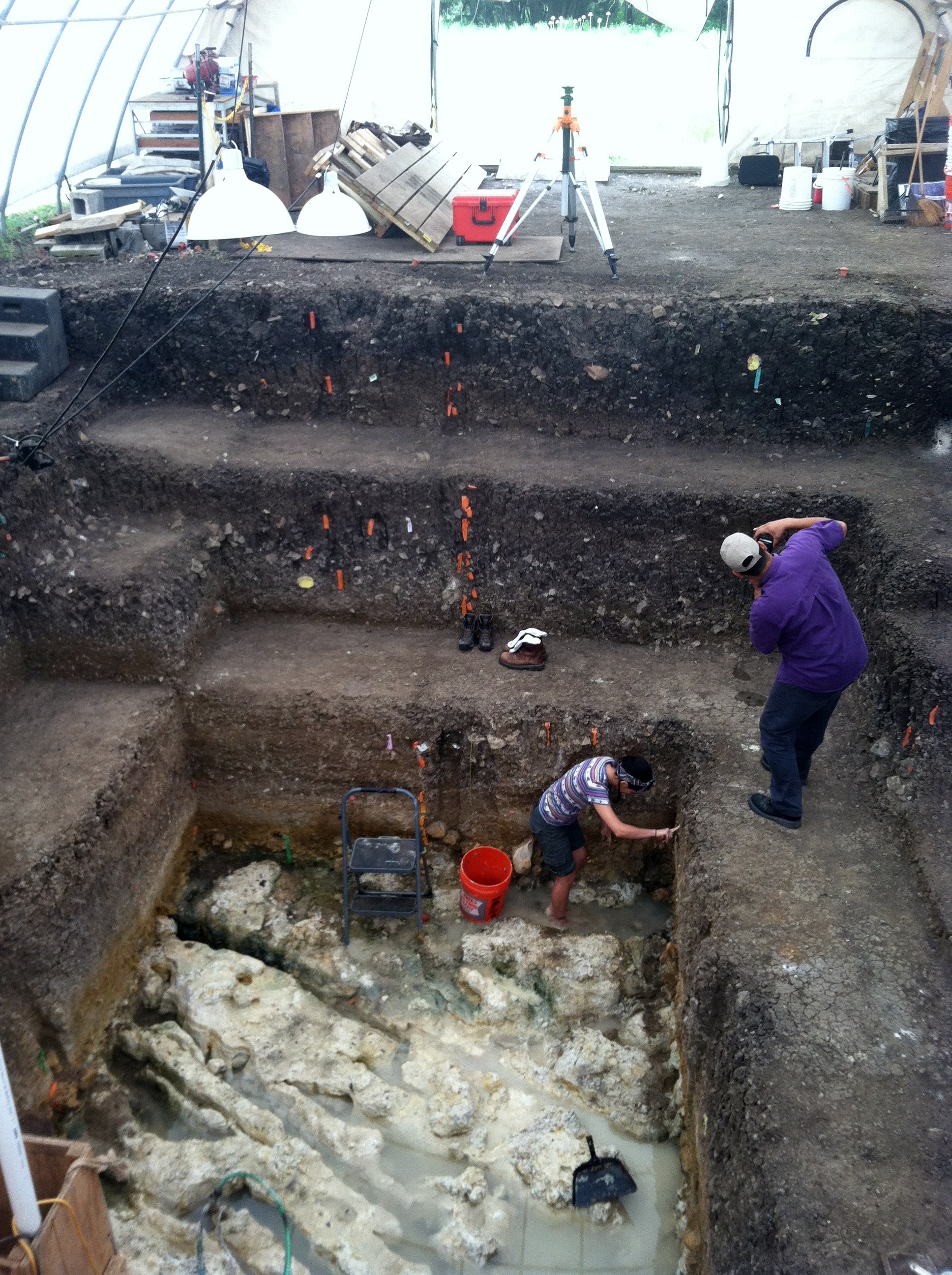
A pre-Clovis toolkit in Texas
Along the banks of Buttermilk Creek in central Texas, archaeologists unearthed a find that reshaped the timeline of human presence in the Americas. At a location named the Debra L. Friedkin site, a team led by Michael R. Waters from Texas A&M University discovered a dense layer of stone artifacts buried in ancient sediment. This collection, now known as the Buttermilk Creek Complex, was found in a clearly defined geological layer just below sediment containing artifacts of the Clovis culture. The discovery provides the most robust evidence for human occupation of the continent before Clovis.
The stratigraphic separation is distinct. The pre-Clovis artifacts are situated within a 20-centimeter-thick layer of clay. This entire layer rests beneath the Clovis horizon, which is itself only about 2.5 centimeters thick. This shows that the Buttermilk Creek tools were deposited first. To determine the age of the find, researchers used a method called Optically Stimulated Luminescence (OSL). This technique analyzes mineral grains in the soil to find out when they were last exposed to sunlight. The results from dozens of samples place the Buttermilk Creek Complex artifacts between 13,200 and 15,500 years old, predating the Clovis layer above by as much as 2,500 years.