A book with two histories
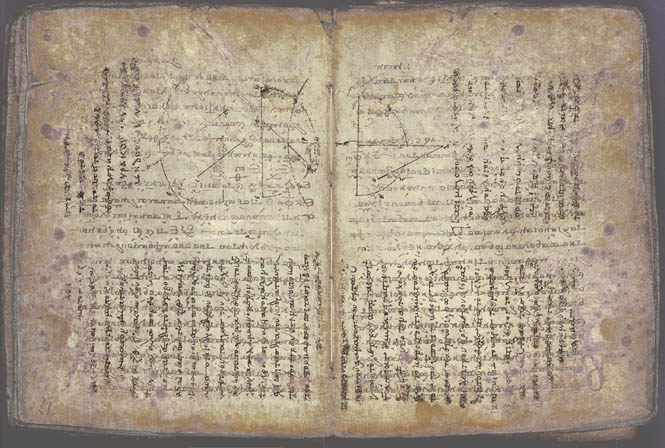
A palimpsest is a recycled book. In an age when parchment, made from durable animal skin, was a valuable commodity, scribes would often take an existing manuscript, scrape and wash its pages, and write a new text over the faint traces of the old one. The Archimedes Palimpsest is one such object, a 13th-century Byzantine prayer book with a hidden, much older text beneath it.
The story begins in the 10th century CE, when a scribe in Constantinople copied several works by the ancient Greek mathematician Archimedes of Syracuse (c. 287–c. 212 BCE). This manuscript contained seven of his treatises. In 1229, likely in Jerusalem, a scribe named Johannes Myronas disassembled the Archimedes codex along with at least six other manuscripts. He scraped the ink from the parchment, cut the large leaves in half, rotated them 90 degrees, and bound them into a new book for his Euchologion, or prayer book.
The palimpsest remained in obscurity for centuries. It was catalogued in a Constantinople library in 1899, where it caught the attention of Danish scholar Johan Ludvig Heiberg in 1906. Heiberg identified the faint underlying script as the work of Archimedes and took photographs, making his own transcription. The manuscript then vanished, suffering damage from mold and, at one point, having four forged Byzantine-style paintings added to some pages to increase its value. In 1998, it reappeared at a Christie's auction and was sold for $2.2 million to an anonymous American collector. The new owner deposited it at the Walters Art Museum in Baltimore for conservation and intensive study.
Seeing the invisible
To read the lost text, an international team of scientists and scholars embarked on a decade-long project beginning in 1999. They used multispectral imaging, capturing images of the pages under 12 different wavelengths of light, from ultraviolet to infrared. This process revealed much of the text, but some parts remained unreadable, especially those under the forgeries and heavy stains.
The final breakthrough came from the Stanford Synchrotron Radiation Lightsource. Scientists used a technique called X-ray fluorescence (XRF) imaging. A high-intensity, pencil-thin X-ray beam was scanned across the parchment. The X-rays caused the chemical elements in the manuscript to fluoresce, each element emitting its own characteristic X-ray signature. By mapping the distribution of iron—a important component of the original 10th-century ink—the team could reconstruct the "ghost" of Archimedes' writing with startling clarity.
The results were astonishing. The palimpsest contains the only known surviving copies of two important Archimedes treatises: "The Method of Mechanical Theorems" and "Stomachion." It also holds the only known Greek version of "On Floating Bodies." In "The Method," Archimedes shows how he used principles of physics, like levers and centers of mass, to discover the properties of geometric shapes. He treats areas and volumes as being composed of an infinite number of infinitesimally thin lines or slices—a conceptual leap that comes before development of integral calculus by nearly 2,000 years. The "Stomachion" was was a sophisticated work on combinatorics, analyzing the 17,152 ways a 14-piece dissection puzzle can be reassembled into a square.