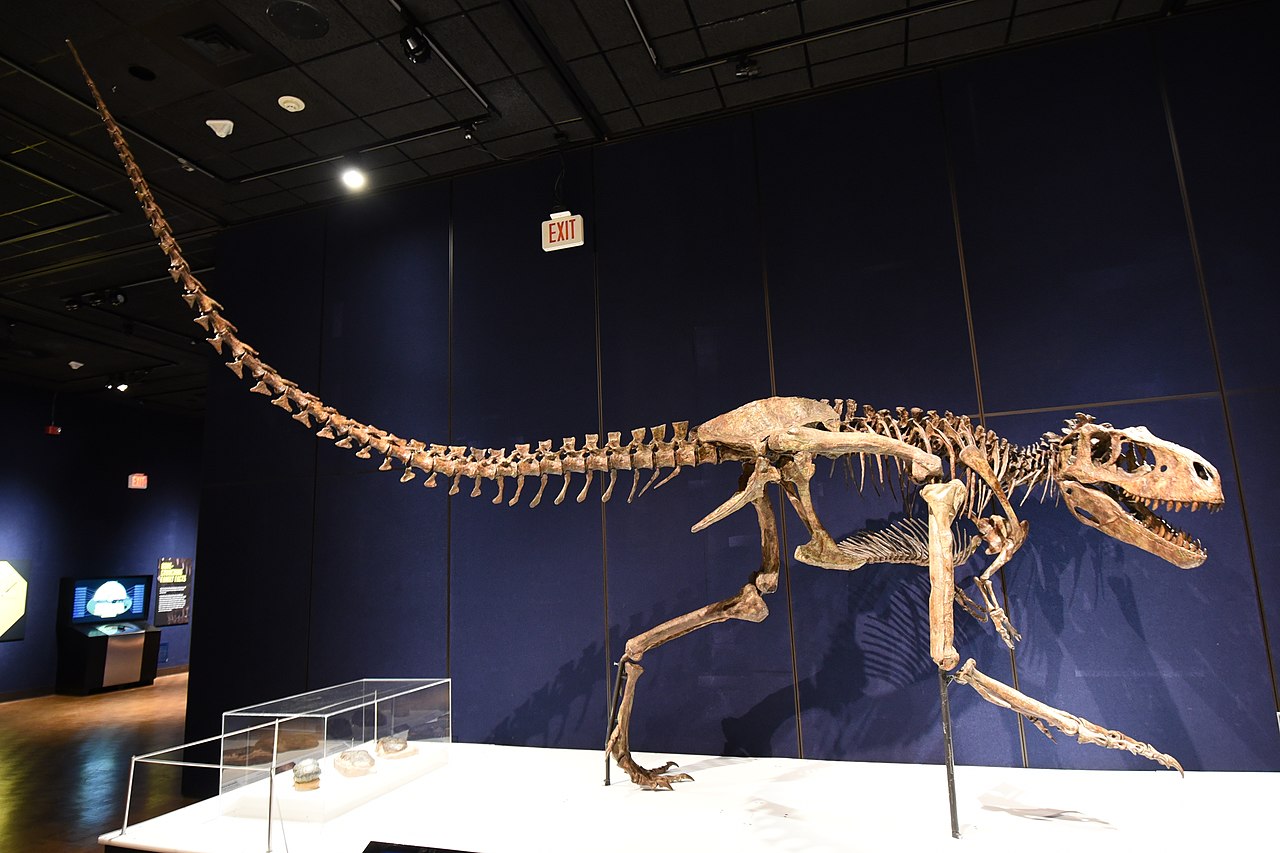
Twenty-six Albertosaurus tyrannosaurs died together 70 million years ago. The only mass death site for large tyrannosaurs ever found. Evidence that these predators lived and hunted in packs, challenging the image of solitary hunters.
WehaveaTrex, CC BY-SA 4.0, via Wikimedia Commons
A catastrophic discovery
In 1910, legendary fossil hunter Barnum Brown was exploring the badlands of the Red Deer River in Alberta when he found a massive deposit of bones. He and his crew from the American Museum of Natural History collected remains from at least nine individuals of the tyrannosaur Albertosaurus sarcophagus. Time constraints forced them to leave much of the site unexcavated, and for decades its exact location was forgotten. It was not until 1997 that paleontologist Philip J. Currie of the Royal Tyrrell Museum of Palaeontology rediscovered the site using Brown's old photographs and notes.
The bonebed is located within what is now Dry Island Buffalo Jump Provincial Park. Renewed excavations by the Royal Tyrrell Museum and later the University of Alberta from 1997 to 2010 uncovered a fossil assemblage. The remains of at least 26 individual Albertosaurus have been identified, making it the largest concentration of large Cretaceous theropods found in one place. The fossils come from the Horseshoe Canyon Formation and date to the Late Cretaceous period, about 71 million years ago. The number of skeletons in one layer shows the life and death of these apex predators.
Reading the bones
The study of how organisms decay and become fossilized is called taphonomy. The Albertosaurus bonebed is a complex taphonomic site. The skeletons are jumbled together, and few are complete. The evidence suggests all the animals died at the same time in a single catastrophic event. The near-total absence of herbivore fossils at the site rules out a predator trap, where carnivores accumulate after being drawn to struggling prey.
Theories for the cause of the mass death include a severe storm, like a hurricane, that caused widespread flooding. This may have drowned the animals or stranded them, leading to starvation or disease. The bodies were then washed into a river channel and buried together. The similar state of preservation for all the individuals supports this single-event hypothesis.
The finding is the age range of the individuals. The group includes six juveniles aged 2 to 11, seven sub-adults aged 12 to 16, eight adults aged 17 to 23, and one very old adult estimated to be 28. The youngest was a two-year-old, about 2 meters (6.6 feet) long and weighing 50 kilograms (110 lbs), while the oldest and largest was over 10 meters (33 feet) long. This multi-generational group structure shows evidence for gregarious, or pack, behavior. It suggests Albertosaurus lived in social groups, perhaps hunting cooperatively, which challenges the image of large tyrannosaurs as solitary animals. While some scientists argue the animals could have been forced together by the disaster, the varied age demographics closely resemble modern social predators.
💡Fun Facts
The name *Albertosaurus sarcophagus* means "flesh-eating lizard from Alberta."
The first *Albertosaurus* fossil was found in Alberta in 1884 by geologist Joseph Burr Tyrrell.
The bonebed contains individuals from nearly every age class, from a 2-year-old to a 28-year-old.
Some of the fossils from the bonebed are on display at the Royal Tyrrell Museum in Drumheller, Alberta, in an exhibit that recreates a pack of *Albertosaurus*.
The park is a day-use area, open from 7:00 a.m. to 11:00 p.m. during its operating season, typically from mid-May to mid-October. The main access road gate is closed outside of these dates.
Admission
Free for day use.
Accessibility
The park is in a remote badlands area with informal hiking trails through coulees and grasslands. The roads and trails contain bentonite, a clay-like material that becomes extremely slippery when wet. Vehicle access to the lower day-use area is not recommended after even light rain.