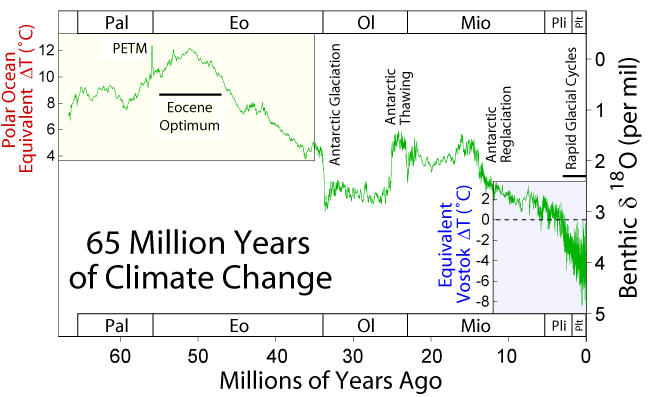
Soil carbonates recording a sudden CO2 spike 56 million years ago. The signature of the Paleocene-Eocene Thermal Maximum that cooked the planet.
Robert A. Rohde, CC BY-SA 3.0, via Wikimedia Commons
A 200,000-year-long fever
The unassuming soil and rock layers near Termez hold a dramatic chemical record of a past global catastrophe. Preserved within the Paleogene sediments are soil carbonates that document a massive and rapid injection of carbon into Earth's atmosphere around 56 million years ago. This event, known as the Paleocene-Eocene Thermal Maximum (PETM), was a brief, intense period of global warming that lasted for about 200,000 years.
The evidence is in the carbon isotopes. Scientists analyze the ratio of two carbon isotopes, carbon-12 (¹²C) and carbon-13 (¹³C). During the PETM, a huge volume of ¹²C-rich carbon was released, causing a sharp negative shift in the ¹³C/¹²C ratio recorded in sediments worldwide. This "negative carbon isotope excursion" (CIE) is the definitive record of the event. In terrestrial records like the paleosols found here, the CIE is particularly pronounced, showing a decrease of 6 to 8 parts per thousand (‰). This indicates a deep disruption of the global carbon cycle. The warming associated with this event was significant, with global average temperatures rising by 5–8 °C (9–14 °F).
The geological formations in the Surkhandarya depression, part of the larger Afghan-Tajik basin, show this time. The Paleogene-aged sedimentary rocks, including limestones and marls, are well-exposed in the region, offering a relatively complete stratigraphic section across the Paleocene-Eocene boundary. This makes the area valuable for studying how terrestrial and shallow marine environments responded to the abrupt climate change.
A planet under pressure
The PETM is a case study of Earth's climate system under stress. The total amount of carbon released during the event is estimated to be in the thousands of petagrams, triggering significant environmental changes. Ocean acidification was a major consequence, as the ocean absorbed vast quantities of CO2. This is evidenced by the widespread dissolution of calcium carbonate on the seafloor.
The source of this massive carbon release is still debated among scientists. Theories include the thermal dissociation of methane hydrates from the seafloor, massive volcanic eruptions, or even the impact of a comet. Regardless of the trigger, the result was a super-greenhouse world. Evidence from the high latitudes shows that polar regions were largely ice-free, with alligators living well inside the Arctic Circle.
Studying the PETM section near Termez helps scientists understand the timeline and effects of rapid carbon release. The event caused turnovers in flora and fauna. While some organisms, like deep-sea benthic foraminifera, suffered mass extinctions, others, including many modern mammal groups, rapidly diversified and spread across the globe. The PETM is the most extreme hyperthermal event of the last 65 million years, making geological records like this one in Uzbekistan important for understanding the potential impacts of future climate change.
💡Fun Facts
The PETM warming period lasted for about 200,000 years, longer than the entire existence of modern humans.
During the peak of the PETM, sea surface temperatures off the coast of Antarctica, a location that is near freezing today, were about 20°C (68°F).
The carbon release during the PETM caused a global rise in temperature of 5 to 8 degrees Celsius.
While many deep-sea organisms went extinct, tropical rainforests seem to have thrived, showing an increase in plant diversity.
Accessible at all times; this is an open, natural geological site.
Admission
Free
Accessibility
The terrain consists of natural, potentially rugged rock outcrops and soil exposures. Access may require hiking over uneven ground. Not wheelchair accessible.