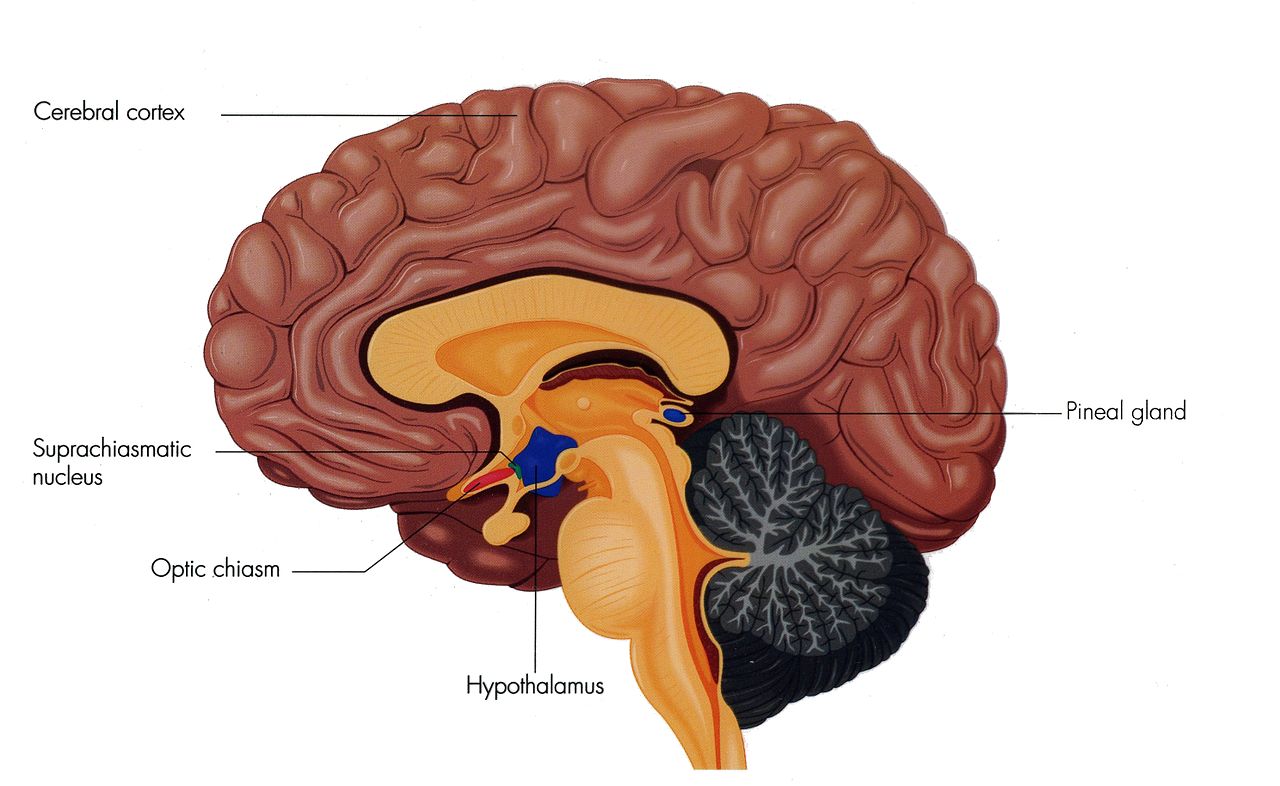
Destroying a rice-grain-sized brain region abolishes all daily rhythms. Transplanting SCN tissue from one animal restores rhythms with the donor's period.
黄雨伞, CC BY-SA 3.0, via Wikimedia Commons
The Clock Removed
In the anterior hypothalamus of a mammal's brain, just above where the optic nerves cross, sits a pair of structures called the suprachiasmatic nuclei, or SCN. Each nucleus in this bilateral cluster contains approximately 10,000 neurons, forming a dense biological clock no bigger than a grain of rice. This tiny region is the body's master pacemaker, dictating the roughly 24-hour cycles of nearly all physiological and behavioral processes. Studies beginning in the early 1970s established the SCN's role through a direct but destructive method: ablation.
Researchers using electrolytic lesions completely destroyed the SCN in rodents like hamsters and rats. The results were immediate and absolute. The animals lost all circadian rhythmicity. Their sleep-wake cycles vanished, with activity occurring in random bursts throughout the day and night. Rhythms in body temperature, hormone release, drinking, and feeding were also eliminated. The procedure demonstrated that the SCN is necessary for the generation of circadian rhythms. Without it, the body's internal network of cellular clocks loses its conductor, and timing falls into chaos.
A Donor's Time
The most definitive proof of the SCN's function came from a series of elegant transplantation experiments. In 1988, researchers Michael Menaker and Martin Ralph identified a golden hamster with a genetic mutation, dubbed "tau," that caused it to have a naturally short circadian period—about 20 hours for homozygous mutants, compared to the typical 24 hours. This discovery was a tool for testing the SCN's authority.
The experiment was straightforward: first, researchers would ablate the SCN of a normal, wild-type hamster, rendering it arrhythmic. Then, they would transplant fetal SCN tissue from a 20-hour tau mutant hamster into the brain of the arrhythmic host. The results were remarkable. The host animal's circadian rhythms were restored. Critically, the restored rhythm was not the animal's original 24-hour cycle, but the 20-hour cycle of the donor SCN. When the experiment was reversed—a tau mutant host receiving a wild-type SCN—the restored rhythm was 24 hours long. This proved that the SCN itself generates the period of the rhythm and imposes that timing on the rest of the body. Later studies even showed that SCN tissue placed in a permeable capsule, preventing direct neural connections, could still restore rhythmicity, suggesting control via diffusible chemical signals.
💡Fun Facts
Even when SCN neurons are removed and kept in a petri dish, individual cells continue to fire rhythmically in a roughly 24-hour cycle.
The "tau" mutation was discovered by chance in a single male hamster shipped from a commercial supplier.
The SCN is composed of a "core" region that receives light input from the eyes and a "shell" region, with neuropeptides like vasoactive intestinal peptide (VIP) and arginine vasopressin (AVP) facilitating communication.
While SCN grafts can restore locomotor and gene expression rhythms, they often fail to reinstate more complex endocrine functions like the estrous cycle, suggesting some pathways require direct neural connections.