The lingua franca of the caravan cities
For nearly a millennium, the dominant merchants of the Silk Road were the Sogdians, an Eastern Iranian people centered on the fertile Zarafshan Valley, with Samarkand as its center. From roughly the 4th to the 10th centuries CE, their language was the commercial lingua franca across Central Asia. While Sogdian inscriptions are found from modern-day Kazakhstan to China, Samarkand—or ancient Afrasiab—was the center from which this influence spread.
The Sogdian script evolved from the Aramaic alphabet, the administrative script of the old Achaemenid Empire. Like its predecessor, it was written right-to-left. The earliest significant examples are not grand monuments, and a handful of private and business letters from the early 4th century CE. Discovered by archaeologist Aurel Stein in 1907 in a ruined Chinese watchtower, these "Ancient Letters" were written on paper by Sogdian merchants far from home. One letter, wrapped in silk, was addressed to Samarkand itself, over 3,000 kilometers away. The texts discuss trade in commodities like silver, camphor, and silk, and contain personal pleas, including two letters from a woman named Miwnay who was abandoned by her husband in Dunhuang.
In Samarkand, the place with evidence of this written culture is the Afrasiab Museum. The museum is built on the archaeological mound of the ancient city and houses frescoes from a 7th-century private residence. These paintings depict diplomatic life, and several figures have small Sogdian inscriptions identifying them. Archaeologists at Afrasiab have also unearthed more mundane texts, such as a 16 cm-long willow stick from the 6th or 7th century recording a debt of 150 silver staters—about 2.5 kg of silver.
A script's genetic legacy
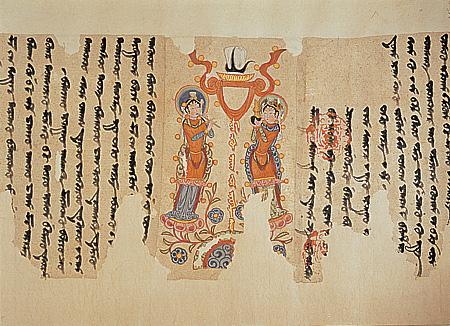
The Sogdian alphabet's legacy is its extensive family tree. The script was adopted around the 8th or 9th century by the Old Uyghurs, a Turkic people, to write their own language. This adaptation involved a significant change: the script was rotated 90 degrees to be written vertically, from top to bottom in columns running left to right, possibly to emulate Chinese writing.
In the early 13th century, Genghis Khan ordered the Old Uyghur script to be adapted for writing the Mongolian language. This new alphabet became the traditional Mongolian script. This script's lineage continued into the 16th century, when the Manchu leader Nurhaci commissioned a writing system for his people, which was based directly on the Mongolian model.
A more speculative connection links Sogdian to Korean hangul. This hypothesis suggests an indirect influence. The 13th-century Mongol 'Phags-pa script, which was derived from Tibetan, may have provided some structural concepts for the creators of hangul in the 15th century. Because 'Phags-pa shares a common ancestor with the Sogdian-derived scripts through the Mongol court, some scholars argue for a distant, though unproven, genetic link.