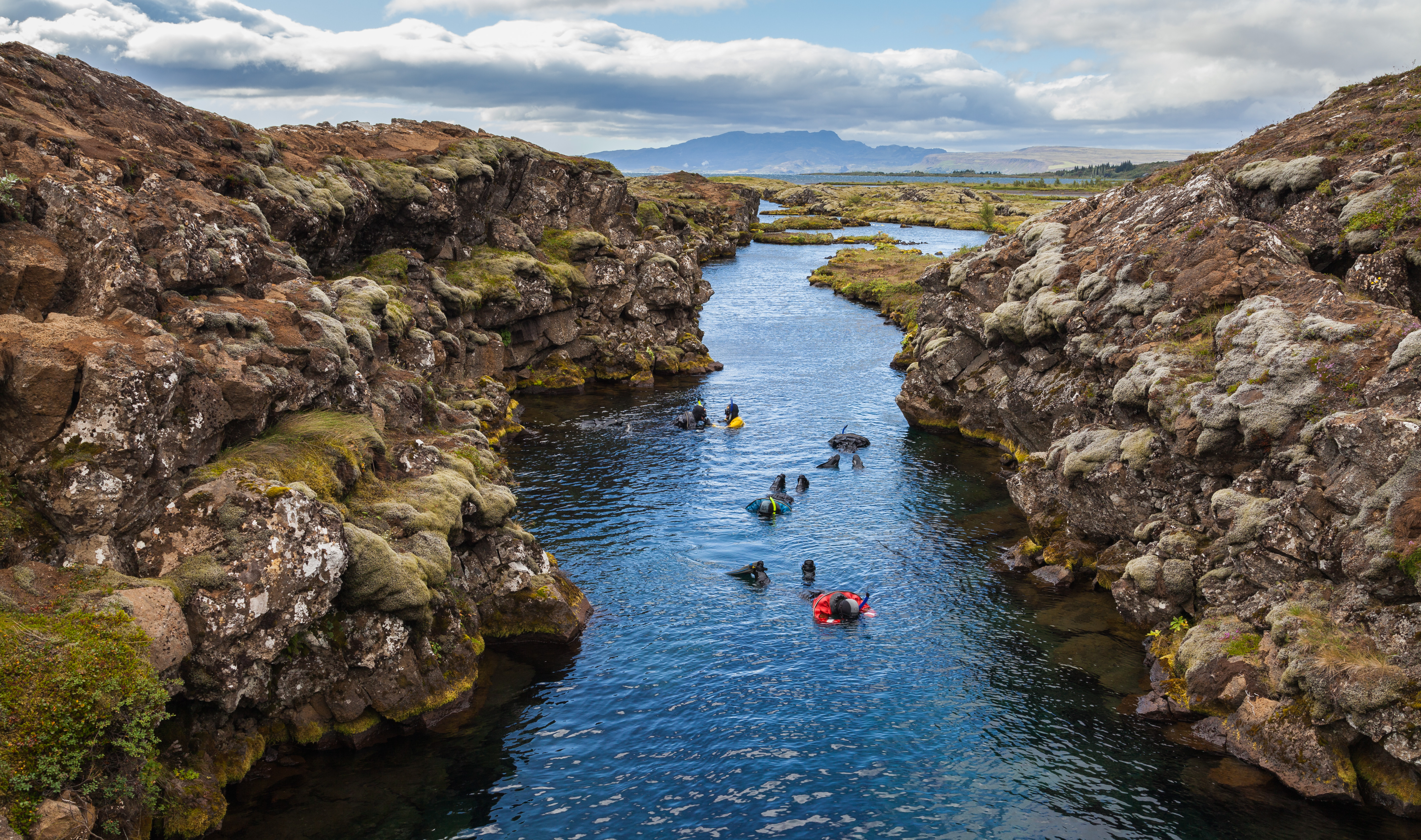
A rift in time
The Silfra Fissure is a tear in the Earth's crust, located within Iceland's Þingvellir National Park, a UNESCO World Heritage Site. This crack; it is the boundary between the North American and Eurasian tectonic plates, one of the few places on the planet where you can see the Mid-Atlantic Ridge on land. The two continents are actively drifting apart here at a rate of about 2 to 2.5 centimeters per year. The fissure itself, which opened during a series of earthquakes in 1789, results from these immense geological pressures.
The water that fills this chasm is astonishingly clear, with underwater visibility that often exceeds 100 meters (328 feet). This is because the water originates as meltwater from the Langjökull glacier, some 50 kilometers away. It then spends between 30 and 100 years filtering through a vast field of porous underground lava rock before seeping into the fissure. This extensive natural filtration process removes nearly all impurities, resulting in some of the purest water on Earth. The constant flow from underground springs keeps the water temperature at a stable 2–4°C (35–39°F) year-round, preventing it from freezing even in the depths of Icelandic winters.
Life in a crystal desert
The extreme purity of Silfra's water means it is ultra-oligotrophic, or exceptionally low in nutrients. This makes it a difficult environment for most aquatic life to survive. Fish from the adjacent Þingvallavatn lake rarely venture into the fissure. The most prominent life forms are varieties of algae, including bright green filamentous algae known as "troll hair," which clings to the submerged basalt walls.
This algae is the base of a very limited food web. The ecosystem also supports matrices of cyanobacteria and microalgae, which form biofilm mats on the rocks. Life here is sparse, but it does exist. A unique species of amphipod crustacean, Crymostygius thingvallensis, is found only in Þingvellir's groundwater systems. The only fish that resides in the fissure year-round is the Dwarf Char, a subspecies of the Arctic Char, which lives deep within the fissure's darker recesses and is seldom seen. The larger Arctic Char may enter the fissure to mate during August and September, but they do not stay. The stunning clarity of the water results from this minimal biological activity.