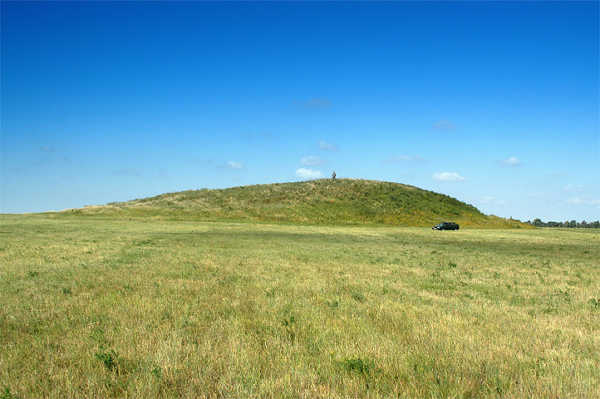
An unexpected discovery in a burial mound
In the Surkhandarya region of southern Uzbekistan, a Bronze Age burial mound known as a kurgan has yielded an astonishing find: fragments of silk. This area was once part of a civilization called the Bactria–Margiana Archaeological Complex (BMAC), or Oxus civilization, which flourished from approximately 2300 to 1700 BCE. The BMAC was known for its monumental architecture, advanced irrigation, and complex crafts, but not for producing silk.
The discovery of any organic material like textiles from this period is exceptionally rare. The textiles survived for millennia, a feat attributable to the specific micro-environment within the tomb. While the broader region is not arid, the conditions within the grave allowed for the preservation of these delicate protein-based fibers. Unlike plant-based fibers such as flax, which preserve better in alkaline conditions, animal fibers like wool and silk are best preserved in acidic environments. The fragments were found alongside other grave goods typical of a high-status burial, suggesting the silk was a valuable commodity.
The find at Shurchi is not the only instance of early textiles in the region; fragments of wool and even some silk have been found at other BMAC sites like Sapallitepa. The quality of the Shurchi fragments allowed for an unprecedented level of scientific analysis, leading to a major re-evaluation of ancient trade networks.
Reading the proteins
To determine the origin of the fabric, scientists employed a technique called palaeoproteomics. This method uses liquid chromatography-tandem mass spectrometry (LC-MS/MS) to identify ancient proteins. By analyzing the protein structure of the fibers, researchers can identify the exact species that produced them. The analysis focused on identifying silk fibroin, the core structural protein of silk.
The results were definitive. The proteins matched those produced by the domesticated silkworm, Bombyx mori. This was evidence of evidence because Bombyx mori was exclusively cultivated in China during the Bronze Age. The species is entirely dependent on humans for its survival and has no wild counterpart. Finding its silk in Uzbekistan provides direct, unambiguous proof of contact and trade between the Oxus civilization and Neolithic China.
This single discovery pushes back the timeline for the Silk Road by a full millennium. Previously, the earliest confirmed silk found outside China was in an Egyptian tomb dating to about 1070 BCE. The Shurchi textiles predate this by centuries. The famous Silk Road network is traditionally considered to have been established in the second century BCE, but these fragments demonstrate that its roots are deeper, connecting distant civilizations across Asia long before previously imagined.