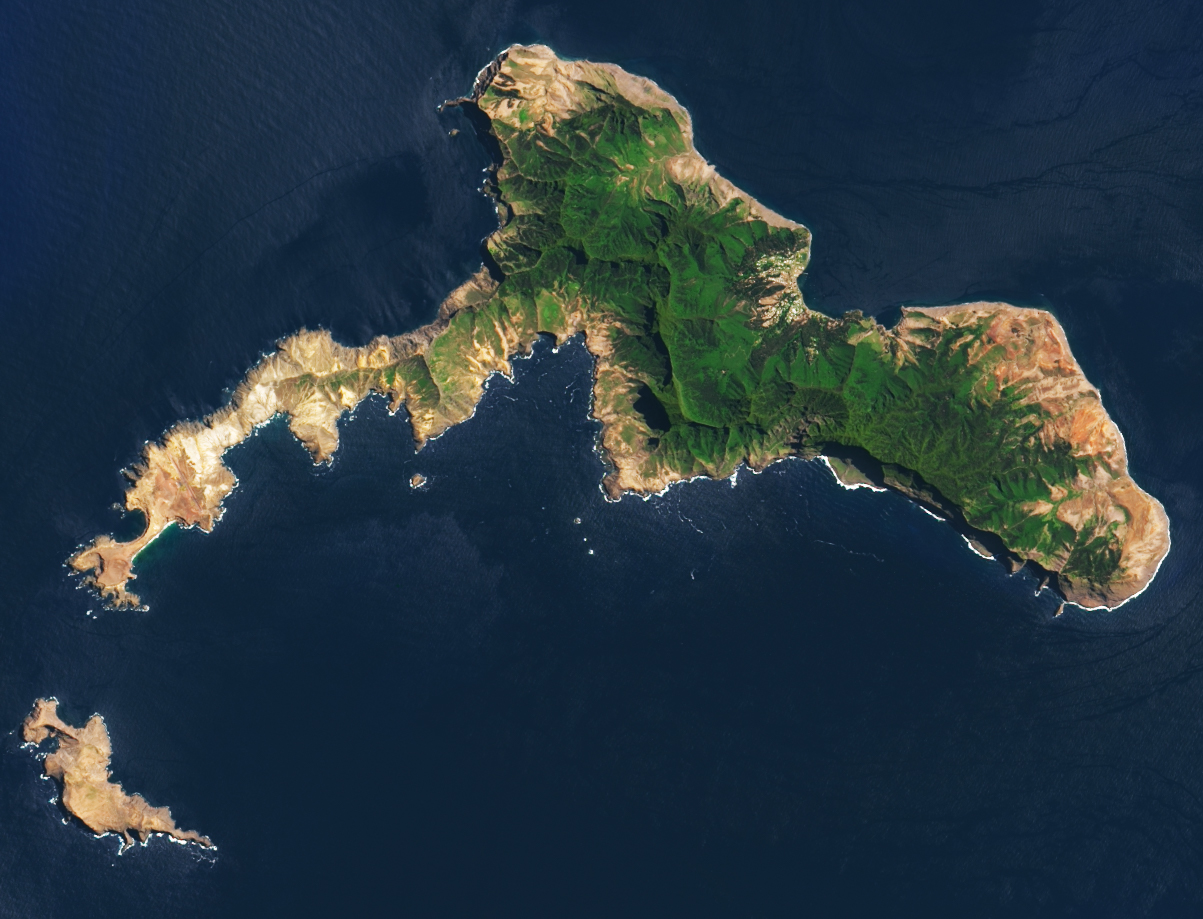
Invasive brambles and rats have driven endemic species extinct. Eradication efforts cost millions. The island is a case study in how introduced species devastate isolated ecosystems.
NASA Earth Observatory images by Lauren Dauphin, using Landsat data from the U.S. Geological Survey. Story by Kathryn Hansen., Public domain, via Wikimedia Commons
A Precarious Paradise
Six hundred and seventy kilometers off the coast of Chile, Robinson Crusoe Island is a hotspot of extraordinary biodiversity. Its volcanic origins and extreme isolation have produced one of the highest densities of endemic plants in the world. Of the 211 native plant species on the island, 132—or 63%—are found nowhere else on Earth. The island is so unique it even has an entire endemic plant family, the Lactoridaceae.
This evolutionary shows extends to its fauna. The Juan Fernández firecrown (Sephanoides fernandensis) is a critically endangered hummingbird endemic to this small landmass. The Juan Fernández fur seal (Arctocephalus philippii), once hunted to near extinction, has recovered from a small group discovered in 1965. The island, part of the larger Juan Fernández Archipelago National Park, was designated a UNESCO Biosphere Reserve in 1977 to protect these species.
An Invasion Decades in the Making
The island's unique ecosystem began to unravel with the arrival of humans. In the 16th century, goats were introduced, followed over the centuries by rats, cats, rabbits, and the South American coati. These new arrivals preyed upon the eggs and chicks of native birds, such as the Juan Fernández firecrown and the pink-footed shearwater. Rabbits, introduced in the 1930s, consumed native plants and caused severe soil erosion.
Invasive plants pose an even greater threat. Species like bramble (Rubus ulmifolius), maqui (Aristotelia chilensis), and murta (Ugni molinae) have spread aggressively. Bramble and maqui alone have colonized up to 90% of the island's native forests, smothering the unique flora that native animals depend on. The sandalwood tree, Santalum fernandezianum, is already extinct, with the last known specimen having been cut down around 1908. Today, 108 of the island's native and endemic plant species are considered endangered or rare, with 14 species having fewer than ten individuals left in the wild.
The fight to reclaim the island is a massive undertaking. Eradicating invasive rabbits from the neighboring island of Santa Clara in 2005 was a major success, but comprehensive removal of all invasive mammals from the archipelago was estimated to cost around $17 million in 2011. Controlling the spread of invasive plants through mechanical and chemical means is an ongoing, difficult process, especially on the island's steep, rugged terrain. These efforts are a costly and urgent attempt to prevent a complete ecosystem collapse.
💡Fun Facts
The island was the real-life residence of marooned sailor Alexander Selkirk from 1704 to 1709, whose story inspired Daniel Defoe's novel *Robinson Crusoe*.
The Juan Fernández fur seal was thought to be extinct for over a century until a small population was rediscovered in 1965.
One of the island's most unusual endemic plants is the Cabbage Tree (*Dendroseris litoralis*), which looks like a cabbage growing on a small tree trunk.
The islands of the Juan Fernández Archipelago have a higher density of endemic plant species per square kilometer than the famous Galápagos Islands.