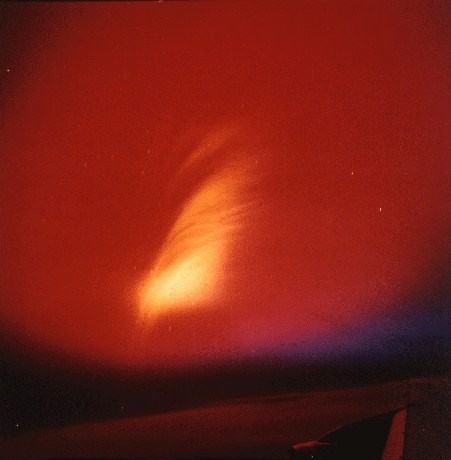
A Star Is Born
At 11:00 PM local time on July 9, 1962, the sky over the Pacific Ocean tore open. A Thor missile, launched from Johnston Atoll, had carried a W49 thermonuclear warhead 400 kilometers (250 miles) into the upper atmosphere and detonated it. The test, codenamed Starfish Prime, had a yield of 1.4 megatons, roughly 100 times more powerful than the bomb dropped on Hiroshima. For several minutes, a blood-red and pink aurora stretched across the sky, visible from Hawaii to New Zealand. Some hotels in Hawaii even held "rainbow bomb" parties on their rooftops to watch the display.
The test was part of Operation Fishbowl, a series designed to study the effects of nuclear weapons in the exo-atmosphere. Earlier high-altitude tests in 1958 had produced unexpected results, and scientists wanted to gather more data on the potential military applications, particularly for anti-ballistic missile systems. The explosion released an estimated 10^29 high-energy electrons that interacted with the Earth's magnetic field, creating the visual effects. But these electrons also produced consequences that scientists had not fully anticipated.
The Pulse and the Poisoned Belts
Almost 1,450 kilometers (900 miles) away in Hawaii, the detonation's effects were felt instantly. A powerful electromagnetic pulse (EMP)—far larger than predicted—surged through the islands. It knocked out about 300 streetlights in Honolulu, triggered countless burglar alarms, and damaged a microwave telephone link, cutting off communication from Kauai to the other islands. Many of the instruments designed to measure the EMP were driven completely off-scale.
A more lasting problem developed in the orbits above. The detonation injected a massive number of charged particles into the Earth's magnetosphere, creating a powerful radiation belt. This man-made extension of the Van Allen belts was far more intense and persistent than expected, with some electrons remaining trapped for over five years. This radiation proved fatal for the nascent satellite infrastructure of the era. Within months, at least seven satellites failed, including the United Kingdom's first satellite, Ariel 1, and the AT&T telecommunications satellite, Telstar 1, which was launched just one day after the test. The test effectively disabled a third of all satellites in low-earth orbit at the time. The unexpected and far-reaching consequences of Starfish Prime led to the Partial Test Ban Treaty of 1963, which prohibited nuclear detonations in the atmosphere, in space, and underwater.