The Ground Becomes the Sea
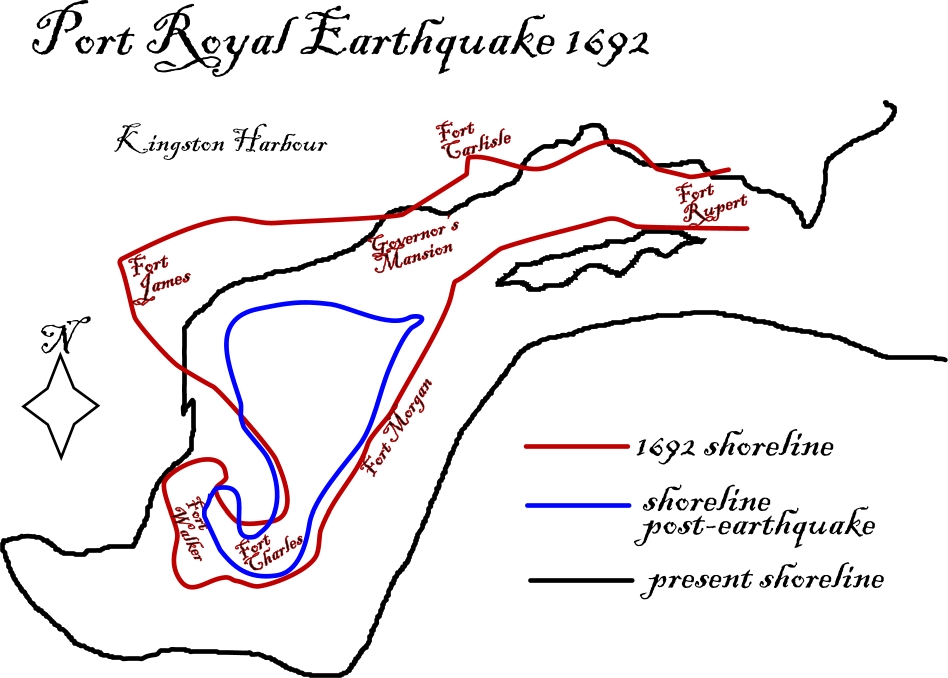
At 11:43 AM on June 7, 1692, a magnitude 7.5 earthquake struck Port Royal, Jamaica. The city, then a wealthy hub for commerce and piracy, was built almost entirely on a long sand spit called the Palisadoes. This foundation of loose, water-saturated sand and gravel was its undoing. The intense seismic shaking dramatically increased the water pressure between the individual sand grains, a process called liquefaction. This eliminated the friction that held the ground together, causing the solid earth to behave like a dense fluid.
Eyewitnesses described the ground swelling and rolling like the waves of the sea. Fissures opened and closed in the streets, swallowing people whole before the sand solidified again, trapping them. The heavy, multi-story brick buildings that had been a sign of the city's wealth lost their foundations and sank into the soupy ground. Within minutes, 33 acres of the city, about two-thirds of its total area, slid into Kingston Harbor. The destruction was so complete that the frigate HMS Swann was reportedly carried by a subsequent tsunami and deposited over the rooftops of the remaining buildings.
An Underwater Pompeii
The earthquake and tsunami killed around 2,000 of Port Royal's 6,500 inhabitants instantly, with another 3,000 dying from injuries and disease in the following days. Unlike many disasters of the era, the event is exceptionally well-documented through letters and accounts from survivors, like the Anglican rector Dr. Emmanuel Heath. These detailed records show the liquefaction event as it unfolded, making it a case study for modern seismologists and engineers.
The submerged portion of Port Royal is now a major underwater archaeological site, often compared to Pompeii because the disaster preserved a specific moment in time. The oxygen-depleted mud of the harbor floor preserved organic materials that would normally decay. Excavations, by Texas A&M University, have recovered thousands of artifacts in situ. One of the most famous finds is a brass pocket watch, made around 1686, which was recovered by explorer Edwin Link in 1959. Its hands are stopped at 11:43 AM, providing the exact time the earthquake struck. The study of this unique "catastrophic site" shows the risks of liquefaction for modern coastal cities built on similar unstable ground.