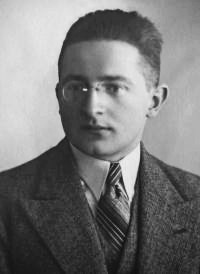
Three Polish mathematicians cracked Enigma in 1932. Seven years before WWII began. And shared their secrets with Britain just weeks before Germany invaded Poland.
Unknown authorUnknown author, CC BY-SA 2.5, via Wikimedia Commons
A Mathematical Assault on Secrecy
This memorial stands near the former location of the Saxon Palace, which between 1930 and 1937 housed the Polish General Staff's Cipher Bureau. Here, a monumental intellectual feat occurred that would change modern history. In late 1932, the 27-year-old Polish mathematician Marian Rejewski achieved the first-ever break of the German military's Enigma machine cipher. The first messages were deciphered around Christmas 1932.
Rejewski, along with his two gifted colleagues from Poznań University, Jerzy Różycki and Henryk Zygalski, did not use stolen codebooks for their daily work. Instead, they used pure mathematics against the machine's intricacies. The German military believed Enigma's 158 million million million possible settings made it unbreakable. Rejewski, however, used group theory and permutation analysis to deduce the secret internal wiring of the machine's rotors. He accomplished this having only seen a commercial version of Enigma, not the military variant. The team exploited a procedural weakness in German operations: operators transmitted a three-letter message key twice at the start of each transmission, creating a mathematical pattern that could be attacked.
From Theory to Electromechanical Bombs
With Enigma's logic exposed, the Cipher Bureau transitioned from theoretical mathematics to applied engineering. Rejewski and his team developed several tools to automate and speed up the decryption process. An early device was the "cyclometer," which helped create a catalog of permutation characteristics. This was followed by the much more ambitious "bomba kryptologiczna" (cryptologic bomb), first built in 1938. Each bomba was an electromechanical aggregate of six replica Enigma machines that could test every possible rotor setting, finding the daily key in about two hours.
Alongside the bomba, Henryk Zygalski developed a manual method known as "Zygalski sheets." These were sets of 26 large paper sheets with up to a thousand precisely cut holes, which, when stacked and aligned over a light box, could also help identify the correct key settings. By 1937, the Cipher Bureau's operations had become so sensitive they were moved from the Saxon Palace to a new, secure facility in the Kabaty Woods south of Warsaw. It was there, on July 25, 1939, just five weeks before the German invasion, that the Poles shared all of their findings—including replica Enigmas, bomba blueprints, and Zygalski sheets—with astonished British and French intelligence officers. This transfer of knowledge was the basis for the Allied code-breaking efforts at Bletchley Park. Historians estimate this work shortened World War II by two to three years.
💡Fun Facts
The memorial is a triangular prism, honoring the three mathematicians who worked together.
The seemingly random numbers covering the memorial's surface contain the names of Rejewski, Różycki, and Zygalski hidden within the sequences.
The Saxon Palace, original home of the Cipher Bureau, was deliberately destroyed by German forces in 1944 after the Warsaw Uprising. Only the arcade housing the Tomb of the Unknown Soldier survived.
The Poles' success was so comprehensive that by 1938 they were reading approximately 75% of all intercepted German Enigma transmissions.