A performance for life
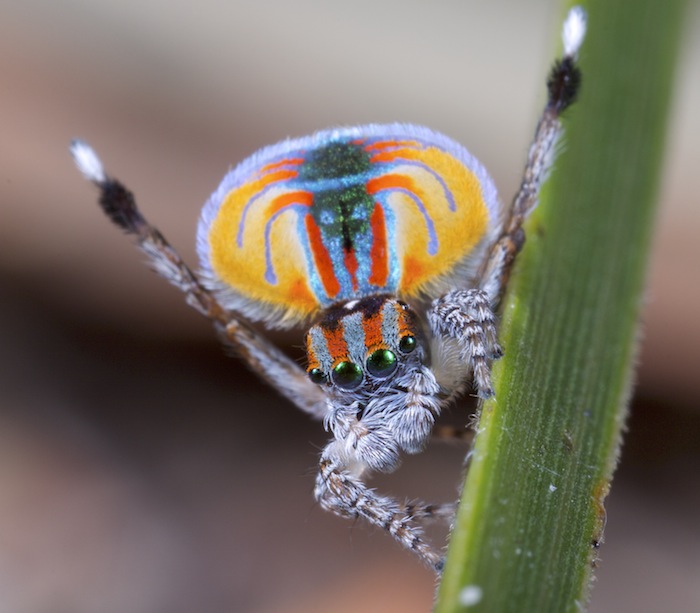
In the leaf litter and scrublands of eastern Australia, a tiny spider performs one of nature's most bright and high-stakes courtship rituals. The male peacock spider, of the genus Maratus, is often no larger than a grain of rice, measuring just 3 to 5 millimeters in length. Despite his small size, he is one of the most colorful creatures in the arachnid world. His abdomen features a pair of foldable, fan-like flaps covered in microscopic scales. These scales are colored with pigments; many produce iridescent blues, greens, and even ultraviolet hues through structural coloration. complex nanoscale gratings on the scales manipulate light to create colors that shift with the viewing angle.
The male's performance is a multi-modal dance aimed at a discerning and potentially dangerous female. He begins by waving his elongated third pair of legs, which are often decorated with tufts of black and white hairs. Once he has the female's attention, he raises his colorful abdominal fan and begins a complex dance. This dance involves side-to-side shuffling, leg waving, and rapid abdominal vibrations. These vibrations, which include types categorized as "rumble-rumps" and "crunch rolls," are seismic signals that travel through the ground to the female, adding to his complex message. The entire display is a sequence of visual and vibratory signals.
The ultimate critic
The female peacock spider is the sole audience and judge of this elaborate show. While the male is colorful, she is typically a cryptic brown or beige. Her survival depends on camouflage, while his reproductive success depends on being seen. She observes the male's dance with eight eyes that provide sharp vision. Peacock spiders can perceive the full color spectrum, including UV light, and their large, forward-facing eyes have a telephoto-like quality, allowing them to resolve fine details. This acute vision enables her to assess every detail of the male's coloration and the precision of his movements.
The stakes for the male are absolute. If the female is impressed by his dance, she may allow him to mate. A successful courtship can last up to 50 minutes. If she is uninterested, or if his performance is lacking, she may attack and eat him. This act of sexual cannibalism ensures that only the most fit and impressive males pass on their genes. The female's choice has driven the evolution of the diverse and brilliant displays seen across the more than 90 species of Maratus. Each species possesses a unique combination of abdominal patterns and dance moves, a direct result of generations of female spiders selecting the most compelling performers.