The Patient Predator
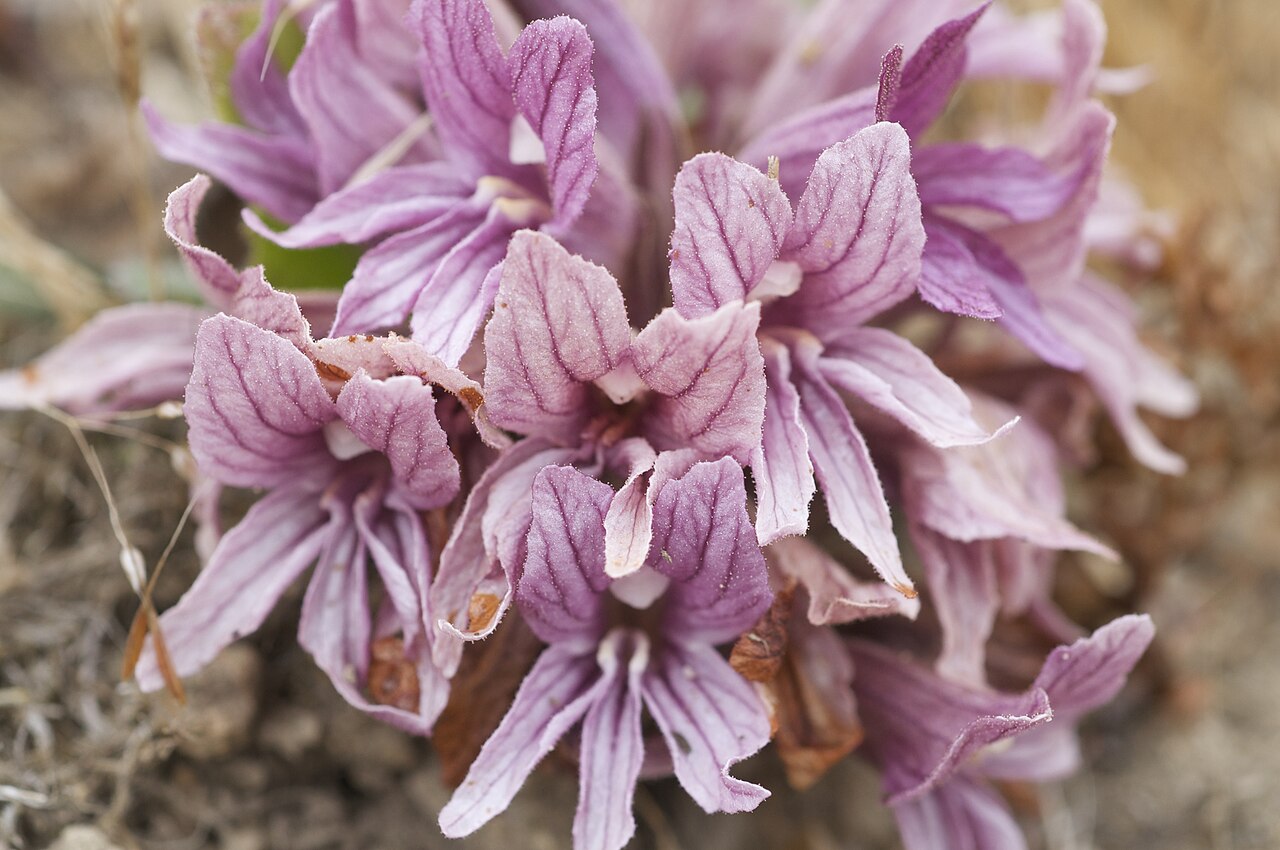
Hidden in the soils of California's coastal sage scrub is a plant that operates like a vampire rather than a typical flower. Orobanche californica, or California Broomrape, is a holoparasite, meaning it derives all of its water and nutrients from another living plant. It completely lacks chlorophyll, the green pigment necessary for photosynthesis, and therefore cannot produce its own food. This makes it entirely dependent on its host. The plant lives most of its life underground as a tuber-like stem attached to the roots of a host. It only becomes visible when it sends up its flowering stalk, a thick, fleshy stem that can reach up to 35 centimeters and is typically coated in glandular hairs. The flowers themselves are tubular, appearing in shades of pale pink, yellowish, or purple, often with distinct veins.
Orobanche californica is a specialist, primarily targeting plants in the Asteraceae family. In the coastal sage scrub habitat, its preferred hosts often include California sagebrush (Artemisia), gumplant (Grindelia), and coyote bush (Baccharis pilularis). To steal from its host, the broomrape develops a specialized organ called a haustorium. This structure grows from the parasite and physically penetrates the host's root tissue, tapping into the xylem and phloem to siphon off water and important nutrients. This intimate and aggressive connection allows the broomrape to thrive at its host's expense.
A Chemical Awakening
The reproductive strategy of California Broomrape is an example of extreme patience and precision. A single plant can produce many thousands of tiny, dust-like seeds that disperse into the soil. These seeds can remain dormant for many years, waiting for the perfect moment to germinate. This event is not random. The seeds are chemically programmed to awaken only when they detect specific compounds, such as strigolactones, exuded by the roots of a suitable host plant. This chemical signal is the green light, indicating that a food source is within reach.
Once triggered, the germinating seed sends out a small, root-like structure. This embryonic root grows only a very short distance, typically less than two millimeters, to make contact with the host root and begin forming the haustorium. This strategy ensures that the seedling does not waste its limited energy reserves by sprouting in a location without a viable host. By waiting for a specific chemical cue, the broomrape maximizes its chances of survival in a high-stakes parasitic lifestyle. The seeds' ability to lie in wait for decades allows the species to persist in an environment even during long periods when host plants are scarce.