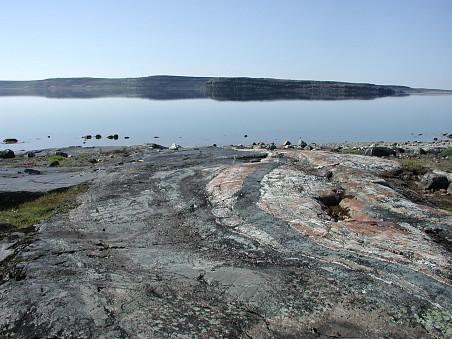
A fragment of the first continent
On the eastern shore of Hudson Bay, about 40 kilometers southeast of the Inuit village of Inukjuak, lies a sequence of dark, weathered bedrock known as the Nuvvuagittuq Greenstone Belt. These metamorphosed volcanic and sedimentary rocks are a candidate for the oldest known rocks on Earth. The dominant rock type is a cummingtonite amphibolite, a mafic rock that has undergone intense heat and pressure. This formation, formerly called the Porpoise Cove Greenstone Belt, is a remnant of what may have been Earth's earliest oceanic crust, and is a physical record of the Hadean Eon.
First mapped in 1965, the belt's extreme age was not confirmed until the 2000s. A 2008 study proposed a stunning age of 4.28 billion years. This date would mean the rocks formed when Earth was only about 270 million years old, suggesting that a solid, water-covered crust appeared much sooner after the planet's formation than many models predicted. The rocks include pillow lavas, which are structures that form when lava erupts underwater, confirming the presence of liquid water oceans in Earth's infancy.
The great dating debate
The 4.28 billion-year age of the Nuvvuagittuq rocks is the subject of intense scientific debate. That ancient date was obtained using samarium-neodymium (Sm-Nd) isotope geochemistry. Specifically, geochemists measured the isotopic ratio of neodymium-142, a decay product of the now-extinct samarium-146 isotope. Samarium-146 was only present during the first 500 million years of Earth’s history, so an anomaly in its decay product points to a Hadean origin.
Other dating methods produce younger ages. Uranium-lead (U-Pb) dating of zircon crystals found in granitic dikes that cut through the greenstone belt gives a minimum age of around 3.75 billion years. Detrital zircons within the belt's sedimentary layers also point to a maximum age of about 3.78 billion years. Many geologists consider U-Pb dating of zircons to be a more robust method for determining the crystallization age of a rock. They argue the older Sm-Nd signature might be an inherited chemical trace from the ancient Hadean mantle that was melted to create these rocks much later, during the Archean Eon. The controversy continues, with each new study adding more detail to the history of Earth's first crust.