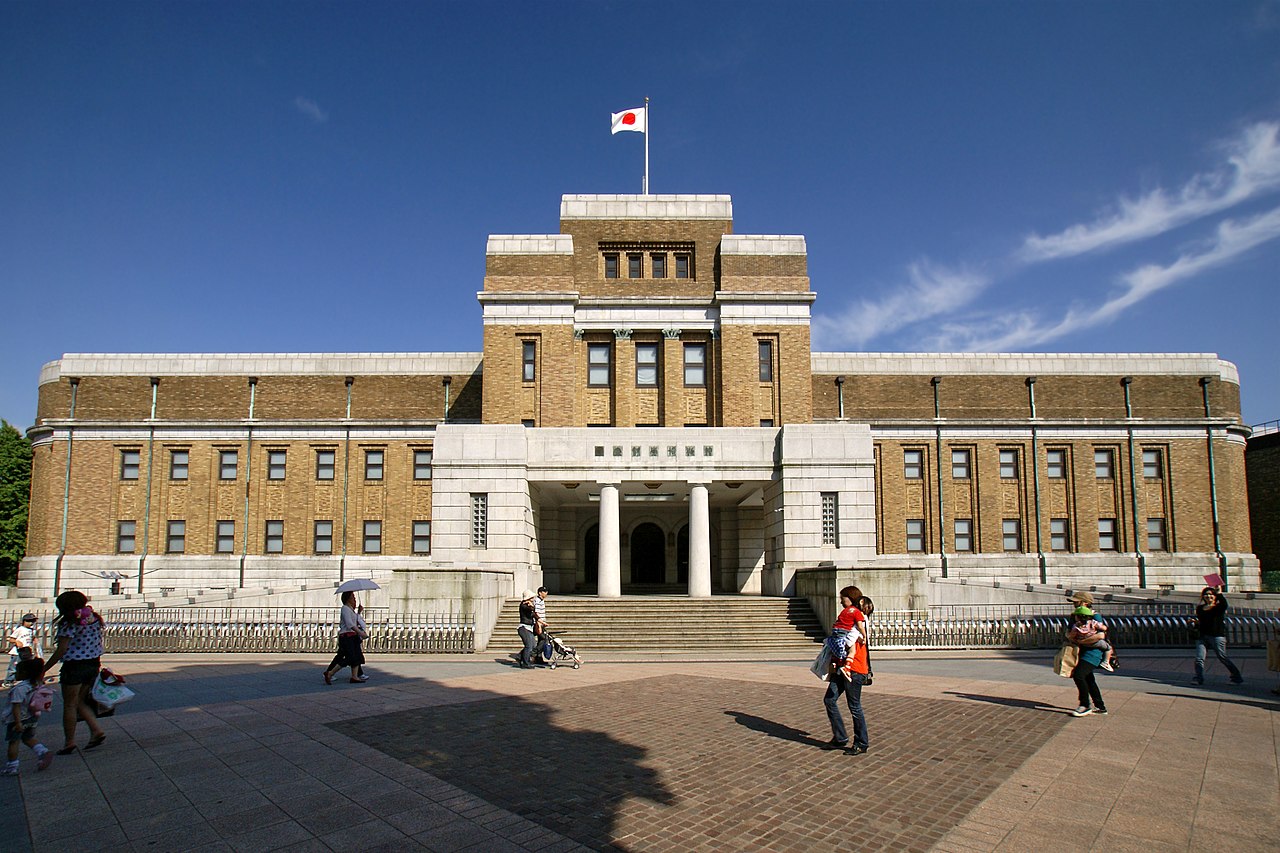
The Japan Gallery
The National Museum of Nature and Science, established in 1877, is divided into two main buildings: the Japan Gallery and the Global Gallery. The Japan Gallery focuses on the natural history and formation of the Japanese islands. One of its famous exhibits is the preserved body of Hachiko, the Akita dog famous for his loyalty. After his death on March 8, 1935, Hachiko's body was taxidermied and has been on display at the museum since June 15, 1935. An autopsy revealed his cause of death was a parasitic infection of roundworms. His preserved organs are stored separately at the University of Tokyo.
This gallery also presents skeletons of dinosaurs and other prehistoric creatures found within the archipelago. Visitors can see fossils of Futabasaurus suzukii, a species of plesiosaur discovered in Fukushima Prefecture. Another display features Kamuysaurus japonicus, a hadrosaurid dinosaur discovered in Hokkaido. The gallery explains the geological history of Japan, the evolution of its flora and fauna, and the history of the Japanese people and their relationship with nature.
The Global Gallery and Technology
The Global Gallery takes a broader view, with a theme of “The History of Life on Earth.” This section has a large collection of taxidermied animals from around the world and numerous dinosaur skeletons. Its exhibits trace the evolution of life through biodiversity and extinction events. An item in this gallery is the Epson HX-20, considered the world's first commercial laptop computer. Released in July 1982, the 1.6 kg machine featured a 120 x 32 pixel LCD screen, a built-in printer, and a microcassette recorder for data storage. It was powered by two Hitachi HD6301 processors, each running at 614 kHz.
The museum's collection extends to space science and technology. It displays a fragment of the Nantan meteorite, which fell in China during the 16th century. Also on view is an original Mitsubishi A6M Zero fighter plane from World War II. The entire museum holds over 25,000 exhibited items that show subjects from outer space to modern technology. Outside the main building, a full-scale, 30-meter-long model of a blue whale is displayed.