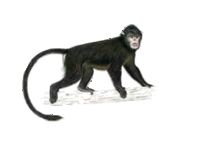
Discovered only in 2010, this monkey sneezes when it rains because water enters its upturned nostrils. Fewer than 300 individuals survive in a shrinking forest fragment.
Rasmus Liedigk, Mouyu Yang, Nina G. Jablonski, Frank Momberg, Thomas Geissmann, Ngwe Lwin, Tony Htin Hla, Zhijin Liu, Bruce Wong, Li Ming, Long Yongcheng, Ya-Ping Zhang, Tilo Nadler, Dietmar Zinner, Christian Roos, CC BY 2.5, via Wikimedia Commons
A Sneeze Leads to a Species
In 2010, a team of scientists surveying for gibbons in the high forests of northeastern Kachin State heard stories from local hunters about a peculiar monkey. The hunters described a black monkey with prominent lips and a bizarrely upturned nose. This anatomical feature had a strange consequence: when it rained, water would collect in the monkey's nostrils, causing it to sneeze loudly. This frequent sneezing made the monkeys easy for hunters to locate, especially during the rainy season. To avoid this, the animals reportedly spend rainy days sitting with their heads tucked between their knees.
Following these accounts, the research team, led by scientists from Fauna & Flora International (FFI) and the local Myanmar Biodiversity and Nature Conservation Association (BANCA), obtained a skull and skin from a hunter. This specimen confirmed the existence of a species new to science. It was formally named Rhinopithecus strykeri in 2011. The species name strykeri honors philanthropist Jon Stryker, whose Arcus Foundation helped fund the expedition. The monkey is known in local dialects as mey nwoah or myuk na tok te, both translating to "monkey with an upturned face". The first live individuals were not photographed until January 2012, when a camera trap captured images of a group in their natural habitat.
An existence on the edge
The Myanmar snub-nosed monkey is almost entirely black, with by white ear tufts, a white chin beard, and a pale perineal area. Males are larger than females, with a head-body length of about 55.5 cm and a long tail of around 78 cm. They are highly arboreal, living in the temperate mixed forests of the eastern Himalayas at altitudes between 1,700 and 3,200 meters. They spend summers at higher elevations and move to lower ground to avoid snow in the winter. Their diet is varied, consisting of over 170 plant species, fungi, and about 15 species of lichens. The ability to digest tough, often toxic lichens is an important adaptation for surviving harsh winters when other food is scarce.
This unique primate is among the most threatened in the world. The International Union for Conservation of Nature (IUCN) lists Rhinopithecus strykeri as Critically Endangered. The total population in Myanmar is estimated to be between 260 and 330 individuals, confined to a small area of about 270 square kilometers. A few smaller populations have since been found across the border in China's Gaoligongshan National Nature Reserve. The primary threats to the species are habitat loss from illegal logging operations and hunting. The monkeys are hunted for their meat, and their bones are sometimes sold for use in traditional medicine. In 2020, the Myanmar government established the Imawbum National Park to protect the monkey's high-elevation forest habitat.
💡Fun Facts
Its local name, *mey nwoah*, means "monkey with an upturned face".
The scientific name *strykeri* honors Jon Stryker, a philanthropist who supported the discovery expedition.
To avoid sneezing in the rain, the monkey often sits with its head tucked between its legs.
The species was first identified by science from a dead specimen provided by a local hunter, which was reportedly eaten shortly after.
This is a critically endangered wild animal living in a remote, conflict-prone, and inaccessible region. It is not a tourist attraction and cannot be visited.
Admission
Not applicable.
Accessibility
The habitat is extremely remote, high-altitude, mountainous forest terrain, requiring specialized scientific expeditions to access.