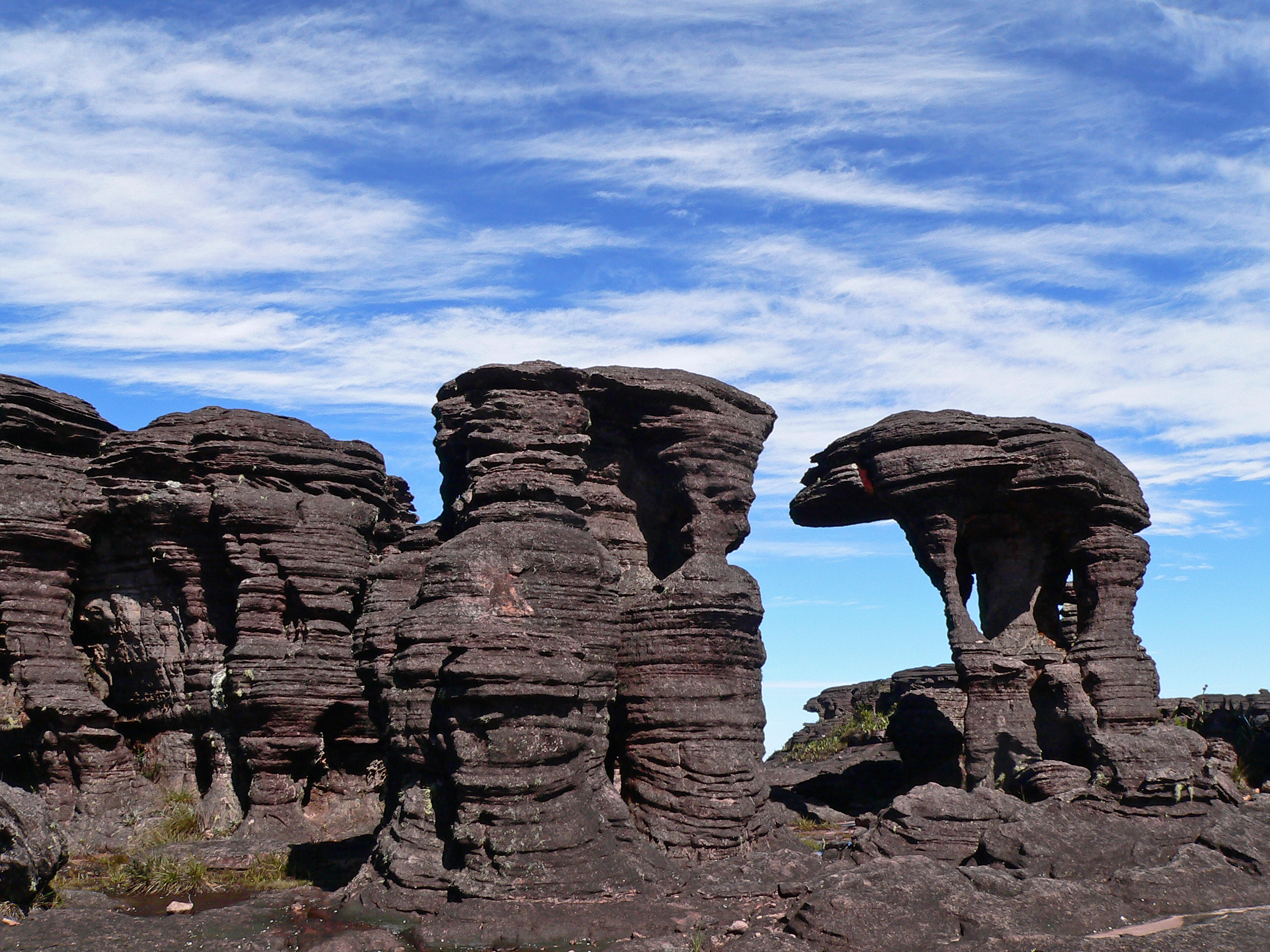
An island in the sky
Mount Roraima's flat-topped summit is a remnant of the ancient Guiana Shield, with rocks dating back 1.7 to 2 billion years to the Paleoproterozoic Era. The plateau is one of the oldest exposed rock surfaces on the planet. The mountain is a tepui, a local Pemon term for these table-top mountains that rise abruptly from the surrounding landscape, with sheer cliffs measuring between 400 and 1,000 meters high. The rock itself is a type of sandstone called quartz arenite, composed of about 98% silica particles, which is highly resistant to weathering. This durability is why the tepui stands today, after eons of erosion stripped away the surrounding, softer land.
The summit sits at an elevation of over 2,700 meters, covering an area of around 31 square kilometers. This isolation created a unique ecological island. The nutrient-poor, acidic soil cannot support extensive vegetation, leaving much of the surface as bare sandstone. What life exists here has adapted in isolation over millions of years. Many species of plants and animals are endemic, meaning they are found nowhere else on Earth. These include carnivorous pitcher plants (Heliamphora) and the tiny Roraima bush toad (Oreophrynella quelchii), a pebble-sized amphibian that rolls into a ball to escape predators.