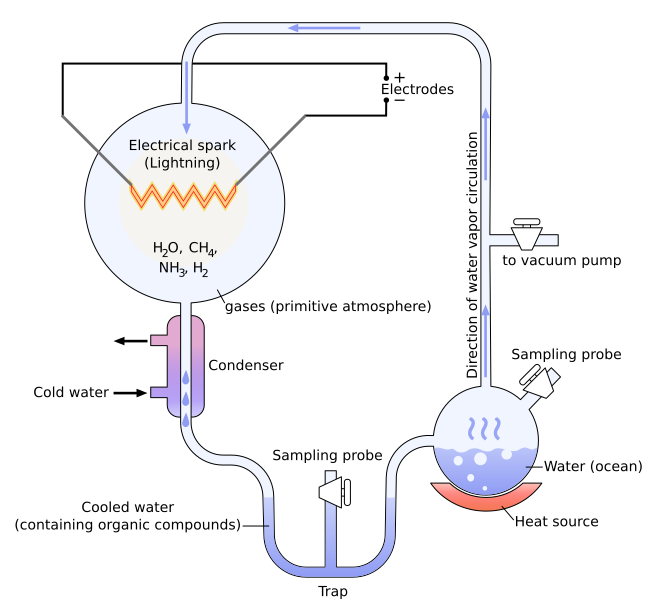
In 1952, a graduate student zapped a flask of simple chemicals with sparks and created the building blocks of life, a 'primordial soup' in a bottle.
GYassineMrabetTalk✉ This W3C-unspecified vector image was created with Inkscape . W3C-validity not checked., CC BY-SA 3.0, via Wikimedia Commons
The spark and the soup
Inside Room 405 of the George Herbert Jones Laboratory in 1952, a graduate student named Stanley Miller, under the supervision of Nobel laureate Harold Urey, assembled a simple apparatus of glass flasks and tubes to test a fundamental question: could the molecules of life arise from non-living chemicals? The experiment was designed to simulate the conditions believed to exist on the early Earth, a concept proposed by scientists Alexander Oparin and J.B.S. Haldane.
The sealed system contained a mixture of gases thought to compose Earth's primitive atmosphere: methane (CH4), ammonia (NH3), and hydrogen (H2). One flask was half-filled with water, representing the primordial ocean. This water was boiled to create vapor, which then mixed with the gases. As the mixture circulated, it passed between two electrodes that delivered a continuous electrical spark, mimicking lightning storms. A condenser then cooled the gas, causing it to liquefy and collect in a U-shaped trap. The experiment ran for a full week.
By the end of the first day, the clear water had turned pink. After a week, the solution was a deep, murky reddish-brown. Miller analyzed the contents using paper chromatography and found something remarkable: the water contained amino acids. Specifically, he identified five types, with glycine and alanine being the most abundant. Amino acids are the building blocks of proteins, the complex molecules that carry out most cellular functions. The experiment was the first proof that organic molecules could be formed from simple inorganic precursors under simulated early Earth conditions.
A legacy in sealed vials
The Miller-Urey experiment changed the scientific conversation about the origin of life, a field of study called abiogenesis. It supported the idea that life could emerge from a "primordial soup" of chemicals. However, over the following decades, a scientific debate emerged regarding the true composition of Earth's early atmosphere. Some geochemists now suggest the atmosphere was less reducing, containing more carbon dioxide and nitrogen.
The story of the experiment took an unexpected turn after Miller's death in 2007. Scientists examining his preserved materials discovered sealed vials containing the dried residue from his original 1952 experiments, including variations he never published. Using modern and more sensitive analytical techniques, researchers re-analyzed the contents. They found that the original experiment had produced many more types of amino acids than Miller had initially reported.
One variation of the experiment, which used a modified apparatus to simulate the conditions of a volcanic eruption, was found to have produced 22 different amino acids. This suggests that early volcanic plumes, full of gases and subject to lightning, could have been highly effective local environments for the synthesis of life's molecular building blocks.
💡Fun Facts
The George Herbert Jones Laboratory holds another significant scientific distinction: in 1942, Room 405 was where Glenn Seaborg's team first isolated and weighed a sample of plutonium as part of the Manhattan Project.
Harold Urey, already a Nobel Prize winner, was initially reluctant to have his name associated with the paper, wanting 23-year-old Stanley Miller to receive full credit for the work.
The murky color of the experimental "soup" was not from the amino acids themselves, but from complex organic polymers called tholins, which are also found in the atmospheres of bodies like Saturn's moon Titan.
The original glass apparatus used in the famous 1952 experiment is not in Chicago; it is on public display at the Denver Museum of Nature & Science.
The George Herbert Jones Laboratory is an active academic and research building. It is not a public museum and there are no official visiting hours. The exterior and the historic marker can be viewed at any time from the public grounds of the University of Chicago campus.
Admission
Free to view from the outside.
Accessibility
The University of Chicago campus is generally flat with paved walkways, making the exterior of the building accessible.