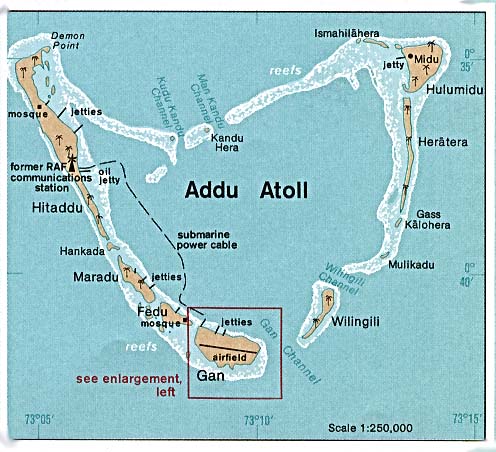
The highest natural point in the entire nation is just 2.4 meters above sea level. Tide gauge records show the islands will be largely uninhabitable by 2100 at current sea level rise rates.
Taken from Perry-Castañeda Library (PCL), originally from CIA Indian Ocean Atlas, Public domain, via Wikimedia Commons
The Lowest High Point on Earth
The Republic of Maldives, a chain of 26 atolls in the Indian Ocean, holds the record for the world's lowest-lying country. More than 80 percent of its 1,190 coral islands are less than 1 meter above sea level. The nation's highest natural point is an unassuming mound on Villingili Island in the southernmost Addu Atoll. This peak stands at just 2.4 meters (7.9 feet) above the surrounding ocean. For comparison, a separate, artificial mound on a golf course on the same island reaches 5.1 meters (16.75 feet).
The existence of the Maldives results from geology and biology working together. The islands are the exposed rims of ancient volcanoes that have long since subsided beneath the waves. The entire archipelago sits atop the Chagos-Laccadive Ridge, a submarine mountain range stretching over 2,350 kilometers. For millions of years, coral polyps built vast reef structures on this volcanic foundation. These reefs grew upwards, keeping pace with fluctuating sea levels over geologic time. Today, the visible islands are composed entirely of coralline limestone and sand, the accumulated remains of these reef ecosystems. This geological history explains the country's exceptionally flat terrain.
An Existential Threat from Rising Seas
The low elevation of the Maldives makes it extremely vulnerable to the effects of climate change, specifically sea level rise. Global sea levels are currently rising at a rate of 3 to 4 millimeters per year, and this rate is expected to accelerate. Projections from the Intergovernmental Panel on Climate Change (IPCC) indicate a potential rise of up to 1 meter by 2100 if greenhouse gas emissions continue at a high rate. For the Maldives, this would be catastrophic, with some studies predicting that 80% of the country could become uninhabitable by 2050 as wave-driven flooding and freshwater shortages become more frequent. Already, 90% of the islands report annual flooding, and 64% experience severe shoreline erosion.
In response, the Maldivian government has launched adaptation strategies. One major effort is land reclamation. The largest project is the creation of Hulhumalé, an artificial island near the capital, Malé, which has been raised to 2 meters above sea level. Construction began in 1997, and the island now houses over 50,000 people, with plans for a population of 200,000. Another massive project, Ras Malé, was launched in 2023 with the goal of reclaiming 1,150 hectares. These projects create higher ground for settlement and infrastructure but come at a high environmental cost, often involving dredging that destroys coral reefs and seagrass meadows. The government also pursues nature-based solutions, such as restoring coral reefs and planting mangroves to protect coastlines, and advocates for global emissions reduction.
💡Fun Facts
The Maldives archipelago is built on a 3-kilometer-thick layer of carbonate sediments that have accumulated since the Eocene epoch.
The country consists of approximately 1,192 islands, grouped into 26 geographic atolls.
Some studies suggest that despite sea level rise, the total land area of the Maldives has grown by as much as 8% in recent decades due to sediment accretion.
The government has explored purchasing land in other countries as a potential relocation option for its citizens.
The natural high point is on an island that formerly housed a resort; public access may be restricted. The previous resort offered tours to the artificial high point on its golf course.
Admission
N/A
Accessibility
The terrain is generally flat and sandy, typical of a coral island.