Primordial Earth
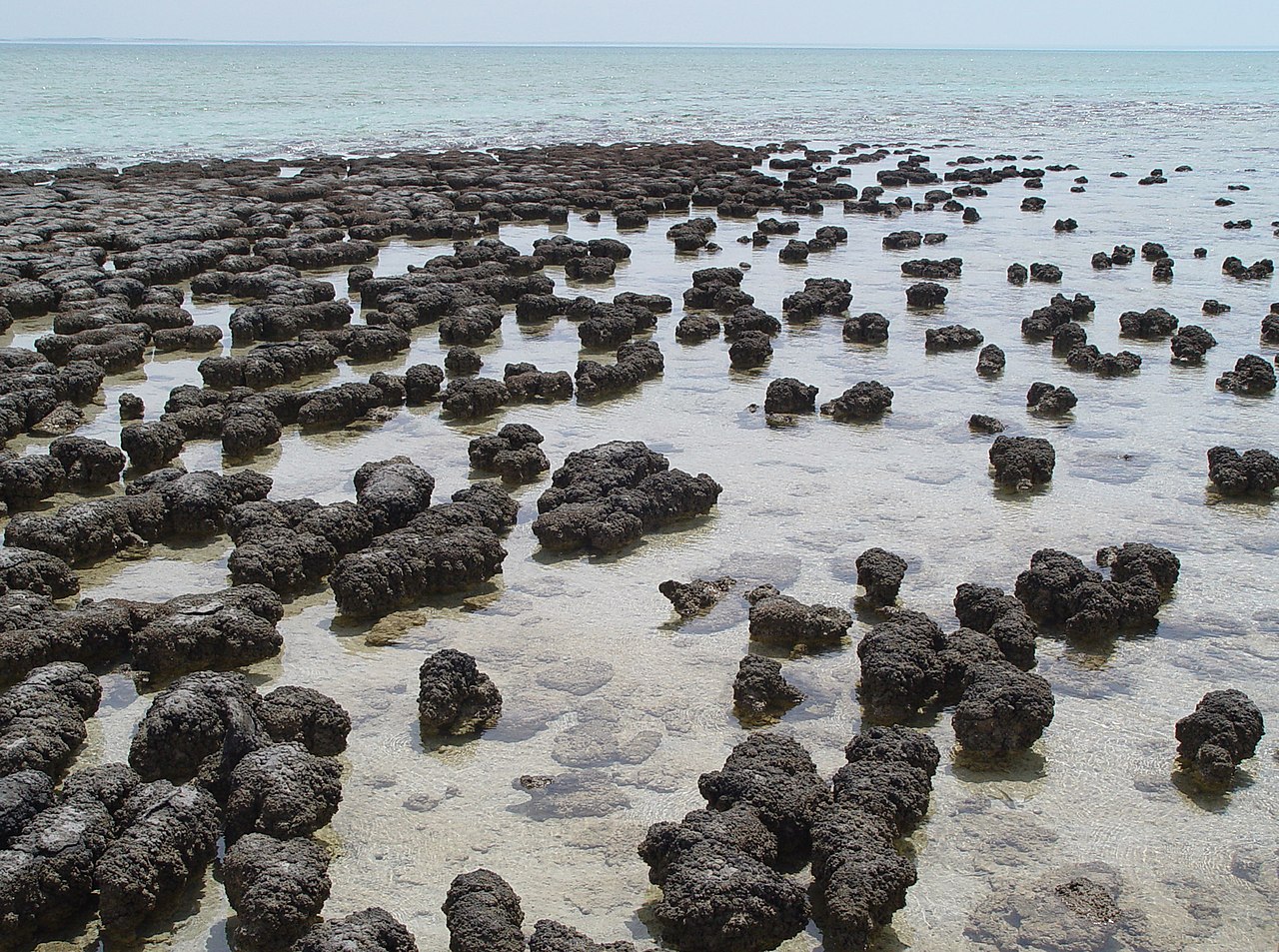
In the shallow, hypersaline water of Hamelin Pool in Shark Bay, Western Australia, lie the most abundant and diverse examples of living stromatolites in the world. These structures, which look like rocky domes and platforms, are modern examples of the earliest known life forms on our planet. They are organo-sedimentary structures built by communities of microorganisms, primarily cyanobacteria. The bacteria live in dense communities on the seabed, sometimes with populations of three billion individuals per square meter. These microbial mats trap particles of sand and crushed shells, cementing them with calcium carbonate to build up the structures layer by layer.
The living stromatolites in Hamelin Pool are relatively young, with the oldest estimated to be between 1,000 and 1,250 years old. Their growth is extremely slow, with long-term vertical growth rates measured at about 0.4 to 0.5 millimeters per year. This means a 35-centimeter-tall column could take a thousand years to form. Their ancient relatives, however, left a much older record. The oldest direct evidence of life on Earth comes from fossilized stromatolites found in the Pilbara Craton of Western Australia, dated to 3.48 billion years old.