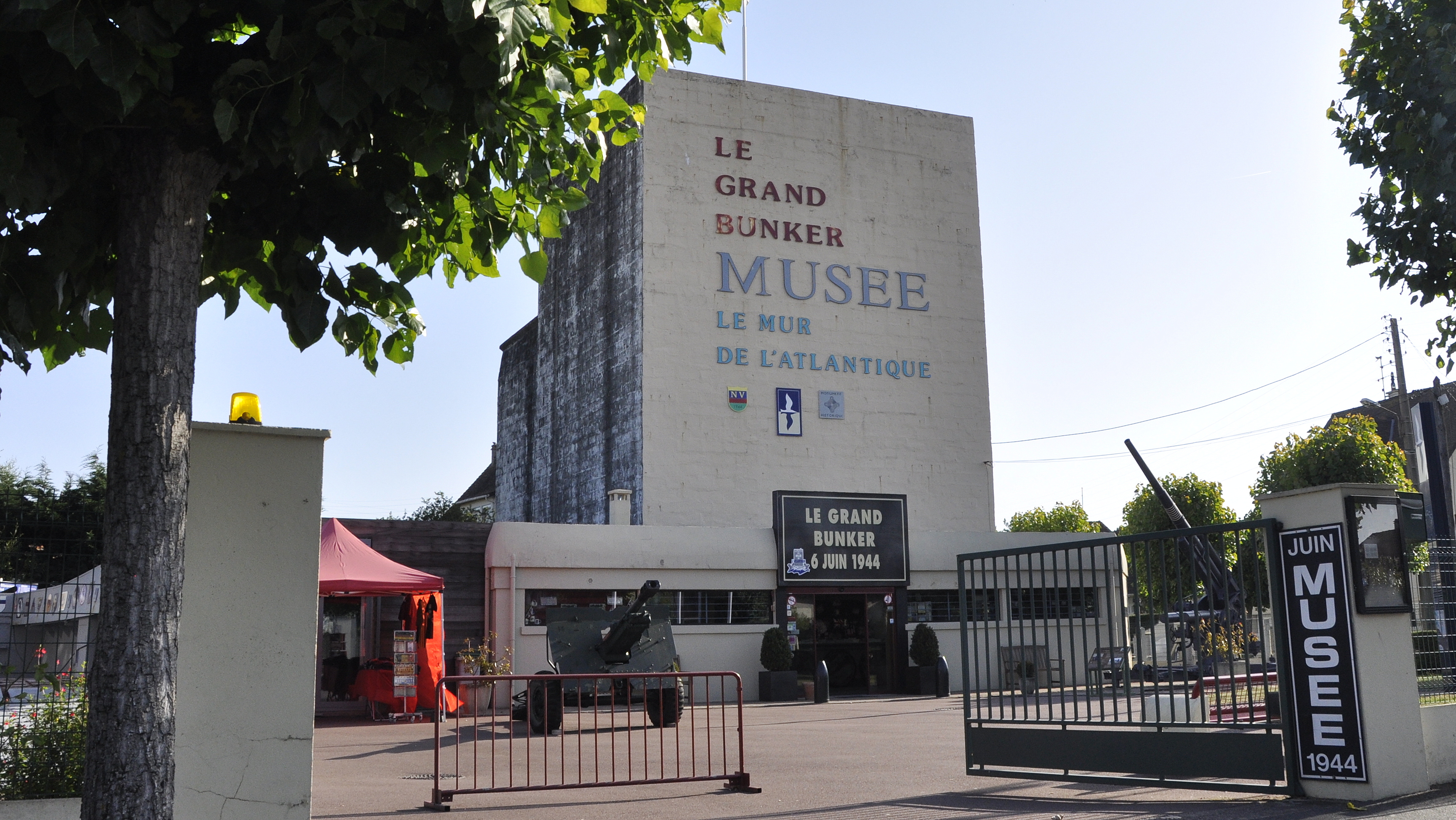
A Concrete Command Post
This 17-meter-high tower is a rare surviving example of a German fire-control bunker, a fortress built to direct the fire of the coastal batteries covering the Orne estuary. As a special construction, or Sonderkonstruktion, it was a unique design adapted for the flat terrain, unlike typical bunkers built into cliffs. The five-story structure gave observers the height needed to aim the six 155mm guns of the nearby battery.
Inside, the bunker's floors are restored to their 1944 appearance, displaying the command-and-control functions that were the building's purpose. The levels contain a generator room, radio transmission rooms, telephone switchboards, and at the top, an observation post with a powerful rangefinder. The German garrison of approximately 52 men was completely self-sufficient, protected by armored doors and a ventilation system with gas filters. On June 6, 1944, Allied commandos made an initial attempt to seize the tower but were repelled by machine-gun fire and grenades. The structure was so robust that it held out for three days before a Royal Engineers team, led by Lieutenant Bob Orrell, spent four hours using explosives to breach the main armored door, forcing the garrison to surrender on June 9.
The Science of Strategic Deception
The soldiers inside the Grand Bunker operated under a complete misapprehension of the battle unfolding around them, a direct result of a sophisticated Allied science-based deception campaign called Operation Fortitude. This operation, part of the larger Operation Bodyguard, was designed to mislead the German high command about the location of the main D-Day invasion. It successfully convinced them that the Normandy landings were a diversion and the primary assault would come later at the Pas-de-Calais.
Operation Fortitude South, the component relevant to Normandy, created a phantom army, the First U.S. Army Group (FUSAG), supposedly positioned in southeast England. This ghost army was made real to German intelligence through several scientific and technical methods. Allies broadcasted huge volumes of fake radio traffic, simulating the day-to-day communications of a massive military force preparing to invade. Physical deception included the deployment of thousands of inflatable rubber tanks and dummy aircraft, convincing enough to fool aerial reconnaissance. This was amplified by double agents, like the Spanish agent codenamed GARBO, who fed false intelligence to the Germans, confirming the existence and intentions of the phantom army. The success of this immense intelligence operation kept critical German reinforcements away from Normandy, buying the Allied forces invaluable time to establish their beachhead.