An evolutionary cauldron
Lake Malawi, the third largest lake in Africa, holds more species of fish than any other lake on Earth. Spanning approximately 580 kilometers in length and reaching a depth of over 700 meters, this body of water formed in the Great Rift Valley between one and two million years ago. It hosts an estimated 1,000 species of cichlid fish, nearly all of which evolved within the lake from a single ancestral species. This explosion of diversity is an example of adaptive radiation, where one lineage rapidly diversifies to fill a wide array of ecological niches. The Lake Malawi cichlid flock represents the most extensive and rapid radiation of vertebrates known.
The engine for this diversification was the lake's dynamic environmental history. Sediment cores reveal that for the last 800,000 years, the lake has fluctuated dramatically. Extended periods of deep, clear water created new rocky shoreline habitats, alternating with periods where the lake was shallow and murky. At times, water levels dropped by nearly 600 meters, isolating populations in separate, smaller lakes. When the waters rose again, these newly diverged populations were reunited, creating a site for new species formation. This cycle of isolation and reconnection, combined with the sheer variety of available habitats, enabled an unparalleled evolutionary event.
The engines of diversity
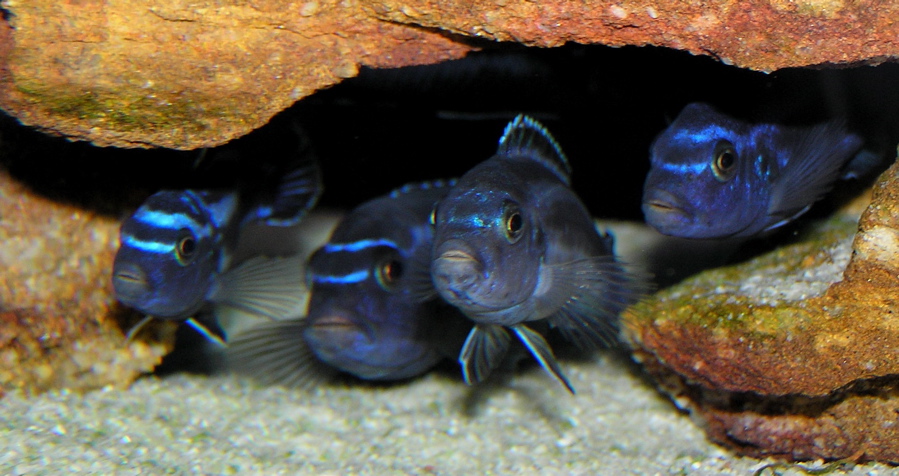
The cichlids of Lake Malawi have adapted to exploit nearly every conceivable food source. This specialization is a primary driver of their diversity. The fish are broadly divided into groups based on their habitat and diet. The most famous are the "mbuna," a word from the local Tonga language meaning "rockfish". These cichlids live among the rocky shores, with specialized teeth adapted for scraping algae off rock surfaces. In contrast, the group known as "utaka" inhabit the open waters, feeding on zooplankton.
Other species have even more specific feeding strategies. Some are piscivores (fish-eaters), some are insectivores, and some are molluscivores, equipped with powerful jaws to crush snail shells. One of the most extreme examples is the scale-eater, Corematodus, which has a mouth twisted to one side and mimics harmless species to get close enough to bite scales off other fish. This intense competition for resources has led to fine-tuned anatomical and behavioral adaptations, carving out hundreds of distinct ecological niches.
Sexual selection is the other critical force behind this radiation. In the clear waters of the lake, vision is important, and female mate choice has driven the evolution of distinct male coloration. Males of different species, even those living side-by-side, possess distinct color patterns that act as reproductive barriers. A female's preference for a specific male color pattern can effectively isolate one population from another, leading to the formation of new species without any geographical separation.