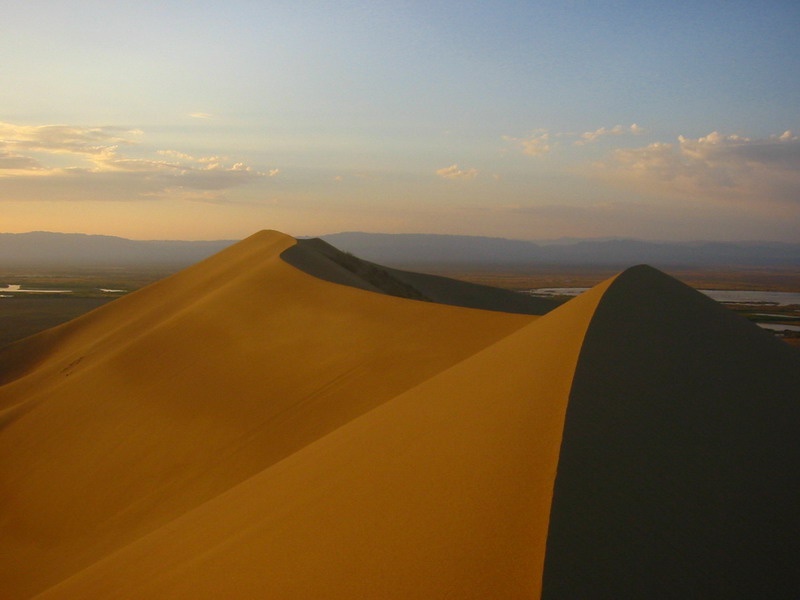
The Physics of a Dune's Song
In about 35 desert locations worldwide, certain sand dunes produce a loud, low-pitched rumble when sand avalanches down their face. The Kyzylkum Desert holds some of these rare "singing dunes." The sound, which can reach 105 decibels and be heard up to 10 kilometers away, is not a trick of the wind but a product of physics. For a dune to sing, a specific set of conditions must be met. The sand grains need to be spherical, contain silica, and measure between 0.1 and 0.5 millimeters in diameter. Most importantly, the sand must be extremely dry; any significant moisture will silence the effect.
The sound begins when sand on a steep slope—typically the crescent-shaped dunes known as barchans—begins to slide. As a layer of sand shears and moves over the stationary sand beneath it, the billions of uniform grains collide and vibrate in unison. This synchronized motion creates pressure waves. The entire face of the dune is the diaphragm of a loudspeaker, amplifying these waves into the powerful hum that reverberates across the desert. The exact frequency of the sound, often between 75 and 105 Hertz, appears to be controlled by the size of the sand grains.
The Kyzylkum's resonating sands
The Kyzylkum, whose name means "Red Sands" in Turkic languages, is a vast desert covering about 300,000 square kilometers. Its geology consists of a large plain with isolated, eroded mountains from the Paleozoic era. The reddish sands are largely formed from the weathering of local bedrock. The arid continental climate, with its hot summers and minimal rainfall, creates the perfect dry conditions necessary for the singing sand phenomenon to occur.
The sound-producing avalanches can be triggered naturally by wind building up sand on the dune's crest until it becomes unstable, or they can be started by a person sliding down the slope. The initial sound can be a series of shorter "burps" as the sand begins to move, which then transitions into a sustained, powerful boom. This booming is caused by P-waves, the same type of fast-traveling pressure waves associated with earthquakes, which get amplified as they propagate through the dune's interior. While the general mechanism is understood, the precise conditions that allow for the synchronization of grain movements are still an active area of research.