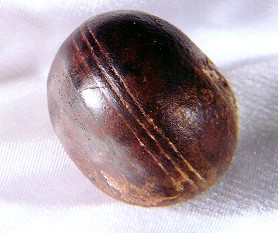
A Precambrian Puzzle
In pyrophyllite mines near Ottosdal, South Africa, miners have for decades been finding small, curious objects. These items, known as the Klerksdorp Spheres, are typically spherical or disc-shaped and range from 0.5 to 10 centimeters in diameter. They are recovered from deposits of pyrophyllite, a soft metamorphic mineral with a Mohs hardness of only 3, that formed approximately 2.8 to 3 billion years ago. This places their origin in the Mesoarchaean Eon, long before the appearance of multicellular life.
The composition of the spheres varies. X-ray diffraction analysis shows they are composed of either hematite (an iron oxide) or wollastonite (a calcium silicate) mixed with hematite and goethite. Unweathered specimens found deep in the pyrophyllite consist of pyrite. Many of the spheres feature striking parallel grooves encircling their equator, which makes them look manufactured. Their hardness is also unusual; some are reported to be harder than steel and cannot be scratched by it, unlike the soft pyrophyllite in which they are found. These characteristics have made them subjects for ancient astronaut theorists and proponents of "out-of-place artifacts" (OOPArts), who argue they are evidence of a prehistoric intelligent civilization.
Nature's Geometric Handiwork
Scientists agree that the Klerksdorp Spheres are natural geological formations known as concretions. Concretions are common phenomena where a mass of mineral matter forms in sedimentary rock. They often form around a central nucleus, with minerals precipitating from aqueous solutions and cementing the surrounding sediment in a spherical shape. This process occurs because the host rock is evenly textured, allowing the concretion to grow unrestricted in all directions.
Geologists theorize the spheres formed in volcanic sediments 3 billion years ago. The grooves are not machined; they are believed to be preserved laminations from the original fine-grained volcanic ash in which they formed. As the concretions grew, they incorporated the texture of these layered sediments, resulting in the parallel ridges. Similar natural grooves appear in concretions found elsewhere, such as the Moqui Marbles in Utah, USA, and in deposits in Schoharie County, New York. The radial internal structure seen in sectioned spheres shows a natural origin, showing mineral growth from a central point outwards. Claims that NASA found the spheres to be perfectly balanced or made in zero gravity are unsubstantiated.