An axe-built cathedral
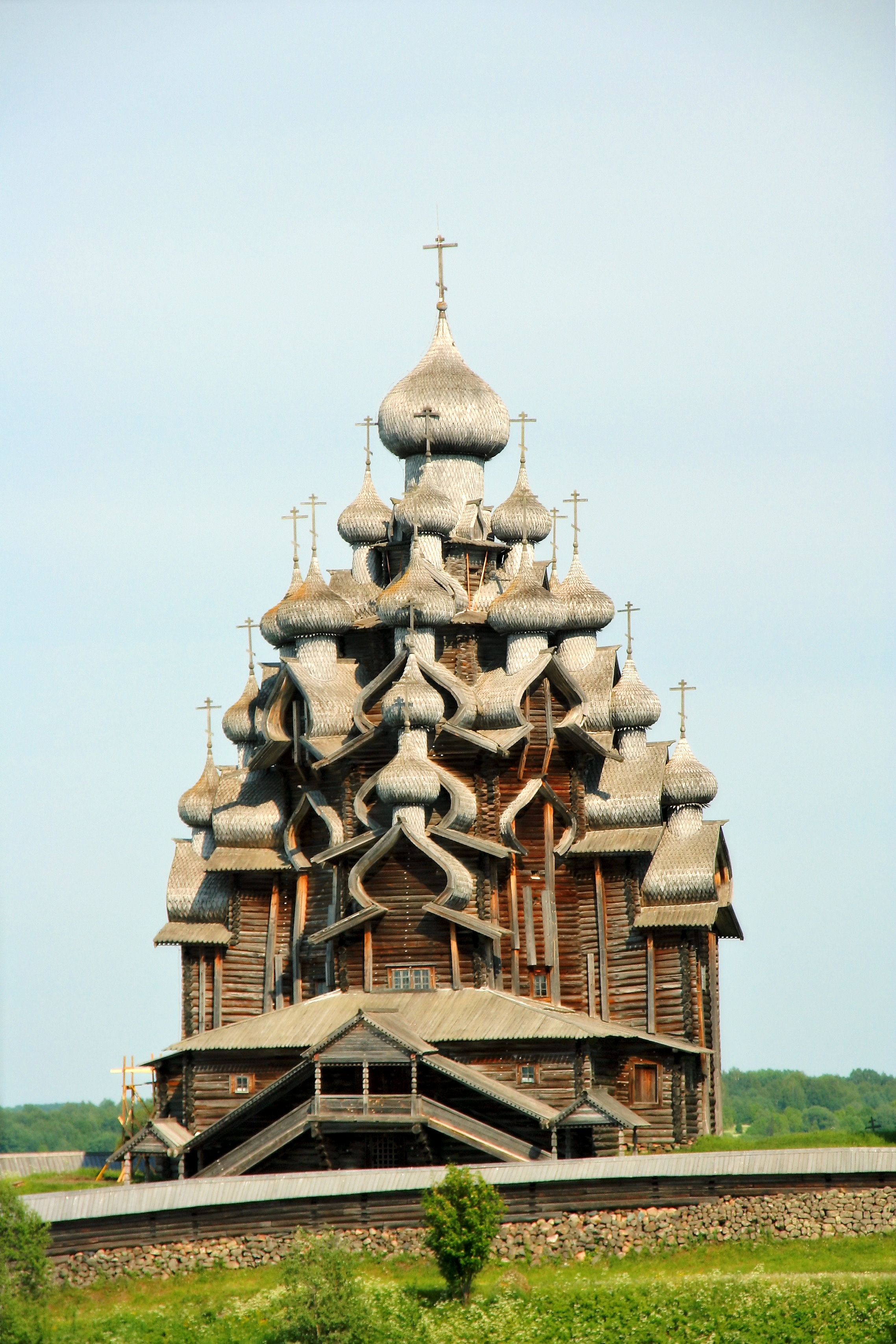
The Kizhi Pogost is an architectural ensemble on an island in Lake Onega, with its centerpiece being the Church of the Transfiguration. This structure, standing 37 meters tall, was completed in 1714 and is one of the tallest log structures in the world. Its construction relies entirely on traditional Russian carpentry, using thousands of horizontally-fitted logs without a single structural nail.
The builders, using primarily axes, shaped logs of Scots Pine (Pinus sylvestris) that were 3 to 5 meters long and around 30 cm in diameter. They employed scribe-fitting techniques, where each log is custom-cut to nest perfectly onto the one below it. This method uses interlocking corner joints, such as round notches and dovetails, to secure the structure. This precise joinery allows the building to flex with changes in humidity and temperature, preventing the wood from splitting. The main structure rests on a stone base with no deep foundation, a common practice for the region.
The church's 22 domes are its most distinct feature. These are covered with tens of thousands of aspen wood shingles. Aspen was the material of choice because it is durable and can be finely shaped with an axe. Over time, exposure to sun and rain has given the shingles a distinct silvery hue.
The science of preservation
By the late 20th century, the 600-ton Church of the Transfiguration faced structural failure. A complex, multi-year restoration project began, guided by principles of minimal intervention. Instead of completely disassembling the church, engineers designed an internal steel frame to support the structure while deteriorated logs were replaced.
Restorers replaced only logs with more than 50% damage, amounting to about 36% of the total structure. To find suitable replacement timber, scientists used dendrochronology (the study of tree rings). This technique allowed them to match the age and physical properties of new Karelian pine logs to the original 18th-century wood. The restoration also involved the meticulous replacement of around 40,000 aspen shingles on the domes, each crafted using historical methods. The project successfully preserved the original architecture while ensuring its stability for the future.
The Kizhi Pogost also includes the nine-domed Church of the Intercession, built in 1764 as a heated "winter" church, and a bell tower from 1862. The entire island is now an open-air museum, preserving dozens of historic wooden structures from the Karelia region.