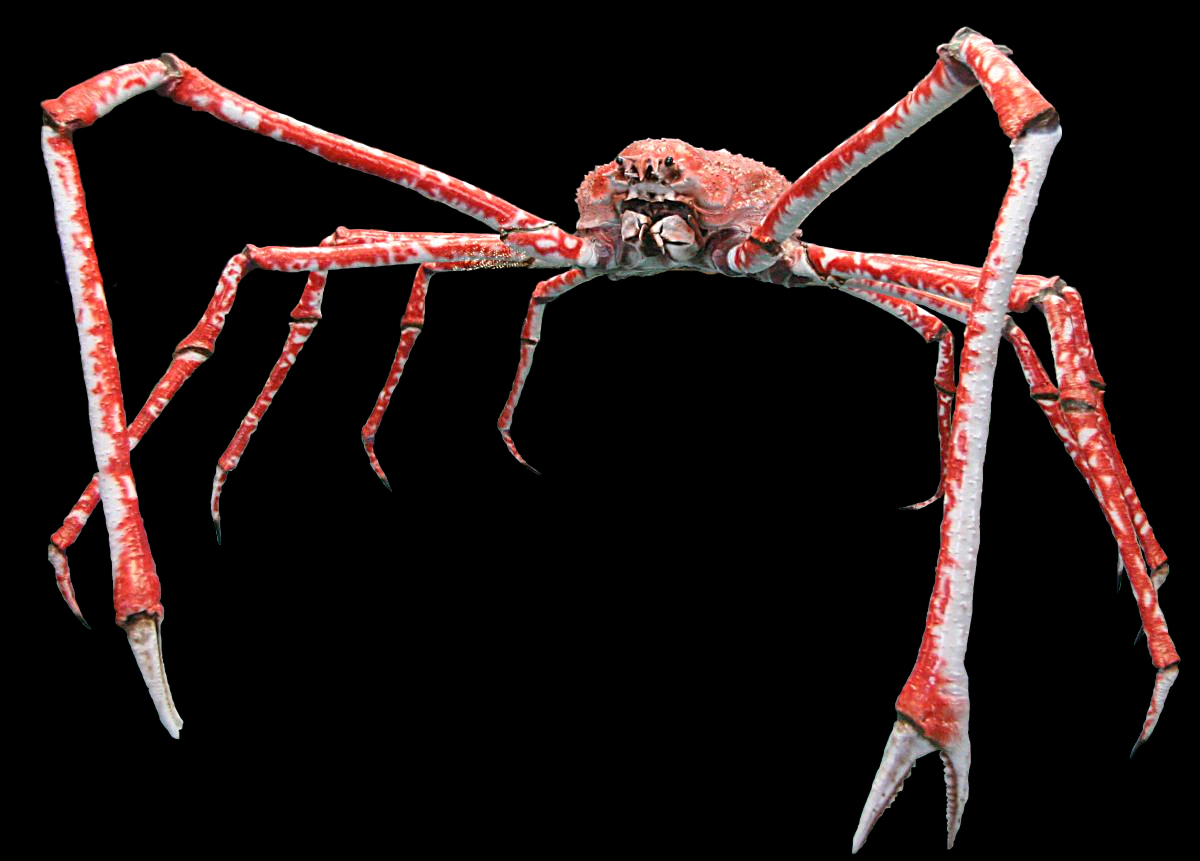
The Deep-Sea Giant
Off the southern coast of the Japanese island of Honshū, in the cold, dark waters of Suruga Bay, lives the planet's largest known arthropod: the Japanese spider crab (Macrocheira kaempferi). This animal achieves its record-breaking dimensions not through a bulky body, but with an enormous leg span that can reach up to 3.7 meters (12.1 feet) from claw to claw. While its legs are immense, the crab's central body, or carapace, is a more modest 40 cm (16 inches) in width. The entire animal can weigh up to 19 kg (42 lbs), making it second in mass among living arthropods only to the American lobster.
The crab inhabits the sandy and rocky floor of the continental shelf, typically at depths between 150 and 300 meters (about 500 to 1,000 feet). However, they have been found as deep as 600 meters (nearly 2,000 feet). In Suruga Bay, the water at a depth of 300 meters is consistently around 10°C (50°F). These cold, oxygen-rich conditions permit the crab's slow metabolism, contributing to its size and longevity. Adults thrive in these chilly depths, while younger crabs tend to live in shallower, warmer waters.
Anatomy of a Colossus
The Japanese spider crab's pear-shaped carapace is covered with short spines and bumps called tubercles, providing a rugged texture. The shell's color is typically a dark orange or light tan, with mottled white spots along its long legs, which helps it blend in with the seabed. As a member of the Majidae family, they are known as "decorator crabs." This behavior involves them affixing sponges, sea anemones, and other marine organisms to their shells for camouflage.
this species has sexual dimorphism. Males have greatly elongated chelipeds (the legs with claws), which can be longer than any of their walking legs. Females, by contrast, have chelipeds that are shorter than their subsequent pair of legs, and their abdomens are wider to accommodate eggs. Despite their appearance and powerful claws, these crabs are known to have a gentle disposition. Their primary diet consists of scavenging for dead animals and plant matter on the ocean floor, though they will also pry open mollusks.
The crab's massive size is achieved through molting, a process where it sheds its rigid exoskeleton to grow. This process is a vulnerable time for the crab. While the carapace stops growing once the crab reaches adulthood, its legs continue to lengthen throughout its life. An individual may live for up to 100 years.