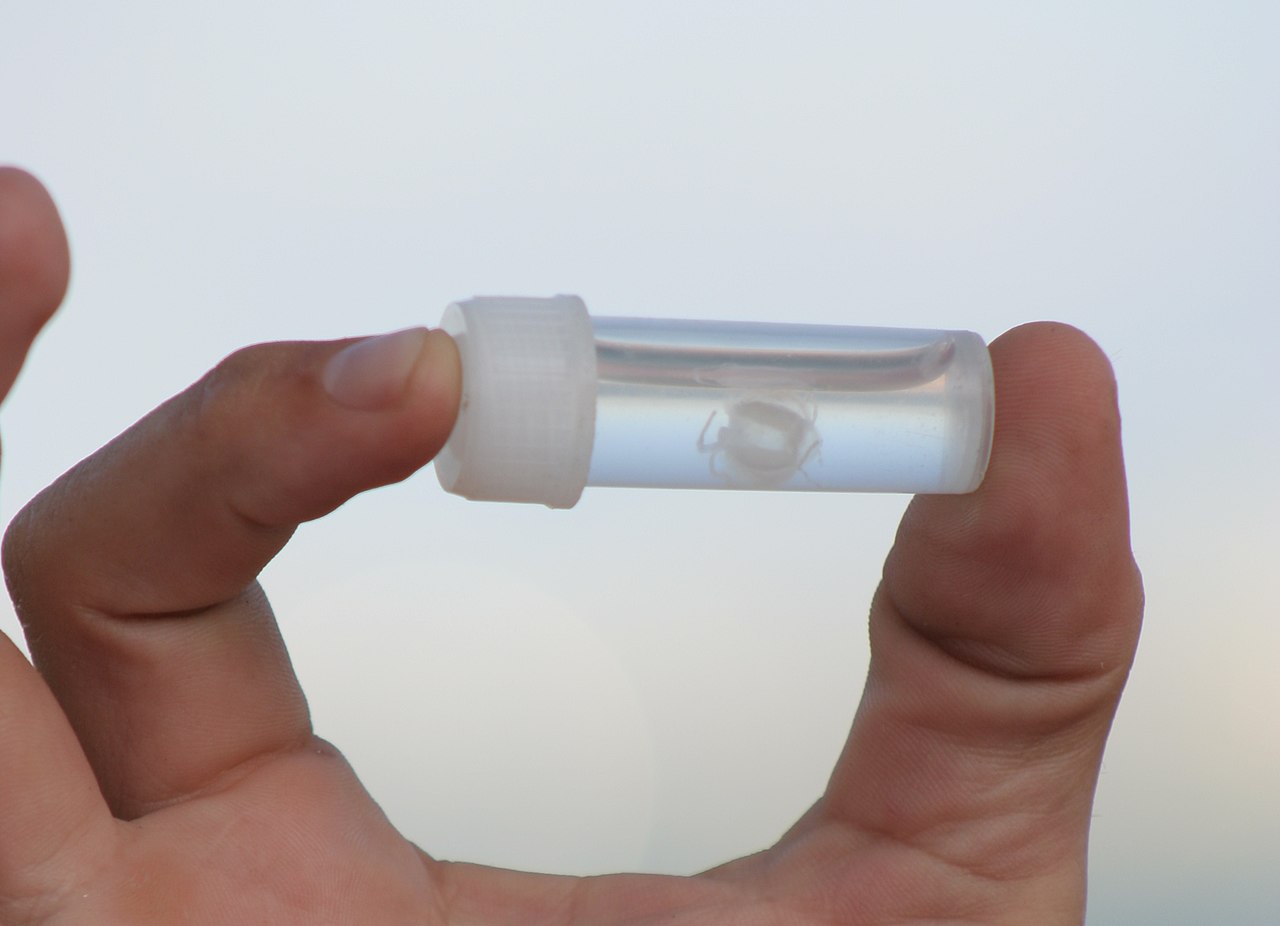
These thumbnail-sized jellyfish deliver stings that cause Irukandji syndrome. Excruciating pain, hypertension, and a sense of impending doom. Venom mechanisms remain poorly understood, making it a critical research subject in neurotoxicology.
GondwanaGirl 04:29, 6 January 2009 (UTC), CC BY-SA 3.0, via Wikimedia Commons
The invisible assailant
In the warm tropical waters of Northern Australia lurks one of the world's most venomous creatures. It is not a large shark or a sea snake, but a nearly invisible box jellyfish, often no wider than a thumbnail. At least 16 different species are known to cause the severe medical condition called Irukandji syndrome, with Carukia barnesi and Malo kingi being the most infamous. The bell of an adult Carukia barnesi can be as small as 1 to 2.5 centimeters in diameter, yet its four trailing tentacles can stretch up to a meter long.
Unlike most jellyfish that have stinging cells, or nematocysts, only on their tentacles, Irukandji jellyfish also possess them on their bell. These nematocysts function like microscopic harpoons, firing a barbed tube that injects venom into a victim upon contact. The initial sting is often described as mild and may go unnoticed, with only a small, goose bump-like welt appearing on the skin. This deceptive mildness is dangerous; victims often feel fine for 20 to 40 minutes before the onset of systemic symptoms.
A cascade of pain
The delayed reaction is the prelude to the full Irukandji syndrome. The venom is thought to trigger a massive release of catecholamines, such as adrenaline and noradrenaline, from the nervous system. This leads to a cascade of agonizing symptoms. Victims experience excruciating muscle pain, particularly in the lower back and abdomen, along with severe headaches, nausea, vomiting, and profuse sweating.
Physiologically, the effects are drastic. The surge of catecholamines causes a rapid heart rate (tachycardia) and dangerously high blood pressure (hypertension). Some patients have recorded blood pressure readings as high as 300/180 mm Hg. This extreme cardiovascular stress can lead to life-threatening complications, including pulmonary edema (fluid in the lungs) and, in rare cases, cardiac failure or intracerebral hemorrhage. A distinct psychological component is also characteristic of the syndrome: a deep sense of anxiety and a feeling of "impending doom". Treatment involves immediate hospitalization for aggressive pain management, often with intravenous opioids, and control of blood pressure.
💡Fun Facts
The syndrome is named after the Irukandji people, an Aboriginal Australian group who have long inhabited the coastal region north of Cairns where stings are common.
In 1961, to prove a tiny jellyfish was the cause, Dr. Jack Barnes deliberately stung himself, his 9-year-old son, and a lifeguard with a specimen he captured. All three became seriously ill and required hospitalization, confirming his hypothesis. The jellyfish was later named *Carukia barnesi* in his honor.
One of the deadliest species, *Malo kingi*, was named for Robert King, an American tourist who died from a sting in Queensland in 2002. His death raised international awareness of the syndrome's lethal potential.
Early research by Jack Barnes into preventing stings led him to wear pantyhose while collecting specimens, a precursor to the modern full-body lycra "stinger suits" now recommended for swimmers.