A Life in the Dark
Hydnora africana is an obligate parasite, meaning it derives all of its nutrients from other living plants. It lives almost its entire life underground as a network of warty brown-grey rhizomes attached to the roots of its host, typically a species of Euphorbia. The plant has no leaves, no stems, and no chlorophyll, making photosynthesis impossible. Its appearance is like a fungus than a plant. The vegetative body connects to its host's roots using specialized structures called haustoria, which penetrate the host tissue to siphon off water and nutrients. For years, the parasite can remain completely hidden, only revealing its existence after sufficient rainfall triggers the growth of its flower, a process that can take over a year from bud to bloom. The flower emerges just 100 to 150 mm above the ground.
Pollination by Deception
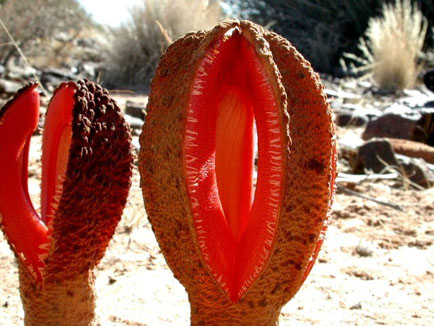
The flower of Hydnora africana is deceptive. Its three or four thick, fleshy lobes are brownish on the outside and a vivid salmon or peachy-orange on the inside. To attract its preferred pollinators—dung beetles and carrion beetles—the flower emits a powerful odor of feces. This scent is produced by spongy white patches called osmophores, which generate chemical compounds like dimethyl disulfide and dimethyl trisulfide.
Lured by the smell, beetles enter the flower through gaps between the lobes. The inner surfaces feature stiff, downward-pointing bristles that prevent the insects from easily escaping. This temporary imprisonment is part of its strategy. The flower is protogynous, the female stigma is receptive before the male anthers release pollen, a mechanism that promotes cross-pollination. Beetles arriving from another flower deposit pollen on the receptive, cushion-like stigma at the base. After a few days, the anthers of the flower release their own sticky pollen, coating the trapped insects. The flower then relaxes its bristles, allowing the pollen-dusted beetles to escape and fly to another unsuspecting bloom.
Underground Fruit and Animal Allies
Following successful pollination, the flower withers and the fruit develops entirely underground, a process that can take up to two years. The resulting berry is subglobose, with a tough, leathery skin, and can grow up to 80 millimeters in diameter. Inside, a gelatinous, starchy pulp contains up to 20,000 small brown seeds. This fruit is edible and sought after by a variety of animals, including jackals, porcupines, baboons, and moles. These animals dig up the ripe fruit to eat it. The seeds pass through their digestive systems unharmed and are dispersed throughout the desert in their droppings, ready to germinate near a new Euphorbia host.
The plant's body and fruit are extremely high in tannins. Traditionally, this astringent property has been used by local communities for tanning leather, preserving fishing nets, and as a folk medicine for treating ailments like diarrhea and dysentery.