An evolutionary paradox in salmon
Deep within the muscle tissue of Pacific salmon, a biological revolution is underway. The perpetrator is Henneguya salminicola, a microscopic parasite that challenges the very definition of what it means to be an animal. In a discovery published in 2020, scientists found that this creature completely lacks a mitochondrial genome. This is significant because all other known animals have mitochondria, the cellular powerhouses that use oxygen to generate energy. H. salminicola has abandoned aerobic respiration, the oxygen-breathing process that powers nearly all animal life.
This organism is a myxozoan, a group of highly simplified parasitic animals that are relatives of jellyfish, corals, and sea anemones. For years, myxozoans were so strange they were classified as protozoans, but DNA evidence confirmed they are cnidarians that have undergone extreme evolutionary changes. As they adapted to a parasitic lifestyle, they shed many complex features, resulting in some of the smallest genomes in the animal kingdom. H. salminicola represents the most extreme example of this reduction. It lost its mitochondria and nearly all the nuclear genes required for their replication and function. However, it retains structures that appear to be mitochondrion-related organelles (MROs), though they lack the genes for respiration.
Life without oxygen
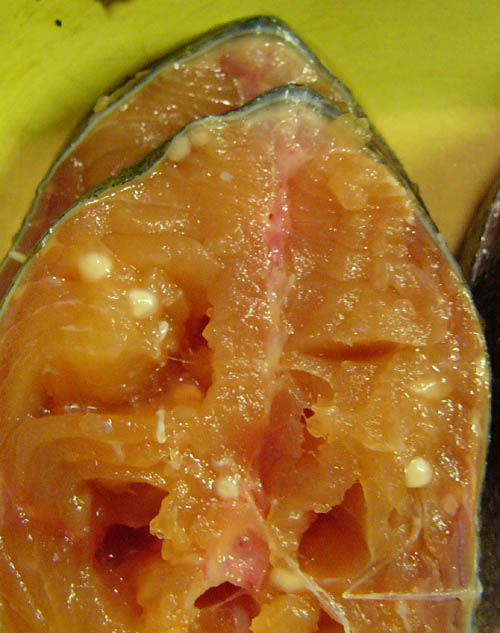
The life of Henneguya salminicola unfolds in a low-oxygen, or hypoxic, environment. It forms small, white cysts, ranging from 3 to 8 millimeters in diameter, within the white muscle of salmonids like Chinook and Coho salmon. This tissue itself is known for having anaerobic metabolism, making it suitable for an organism that cannot process oxygen. The infection, often called "milky flesh" or "tapioca disease," fills the muscle with cysts containing thousands of microscopic spores.
The parasite survives by of metabolic outsourcing. Instead of generating its own energy through respiration, it likely absorbs energy molecules directly from its host's cells. The full mechanism is not yet understood, as the parasite cannot be cultured in a lab. Its complex, two-host life cycle further complicates study. Spores are released into the water when an infected salmon dies and decomposes. These spores are then likely ingested by an invertebrate host, probably a type of annelid worm, where they develop into a new infectious stage. These new forms are then released back into the water to infect the next generation of salmon.