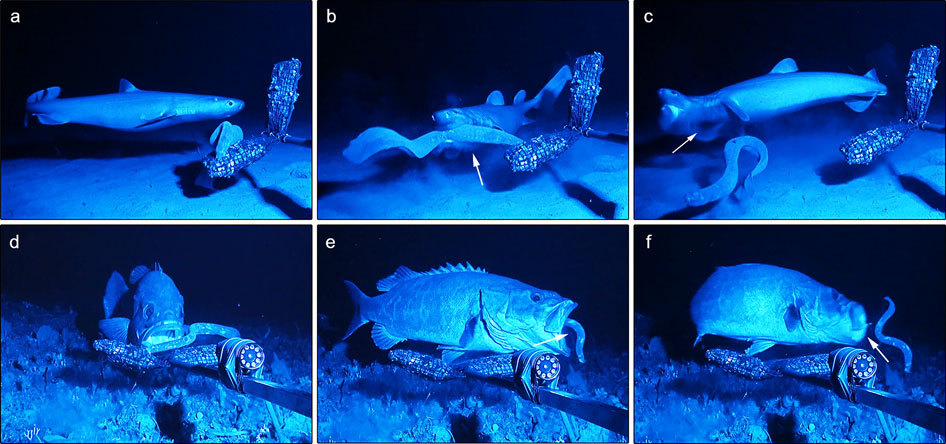
An Instantaneous Gill-Clogging Defense
Deep on the muddy floor of the Pacific Ocean lives a primitive, jawless fish with an exceptionally effective defense mechanism. The Pacific hagfish, Eptatretus stoutii, responds to threats by releasing a glandular exudate that combines with seawater to create a massive volume of gelatinous slime. This deployment happens in less than half a second. The slime is the most dilute hydrogel known, consisting of 99.996% seawater. Its other components are tens of thousands of protein threads and mucus.
The slime is produced by approximately 100 glands arranged in rows along the hagfish's flanks. These glands contain two specialized cell types: gland thread cells (GTCs) and gland mucous cells (GMCs). Each GTC produces a single, coiled protein thread, or skein, that is about 15 cm long but only 1 to 3 micrometers in diameter. GMCs hold thousands of tiny vesicles filled with mucins. When the hagfish is attacked, it secretes these cells, which rupture upon contact with seawater. A protein-based glue holding the thread skeins together dissolves, allowing the threads to rapidly unravel and expand to 10,000 times their initial volume. The mucins swell and mix with the threads, creating a network that entraps a huge amount of water. A single hagfish can produce up to 24 liters of slime from a small amount of exudate. This slime is a fine sieve, effectively clogging the gills of would-be predators and forcing them to release the hagfish to avoid suffocation.
The Escape Knot
Surviving a predator's initial attack is only half the battle; the hagfish must also escape the cloud of its own suffocating slime. To do this, it employs a remarkable display of flexibility. The hagfish ties its elongated, cartilaginous body into a simple overhand knot. It then slides the knot from its head down to its tail. This action works like a squeegee, scraping off the slime and allowing the hagfish to swim away cleanly. The viscosity of the slime decreases under the shearing force of the knot, which makes this self-cleaning process easier.
The Pacific hagfish is particularly acrobatic, capable of forming overhand knots and more complex figure-eight knots. This knotting behavior is not limited to slime removal. Hagfish also use knots to gain leverage when tearing flesh from the carcasses of dead animals they scavenge on the seafloor. Lacking jaws, they drive two pairs of tooth-like rasps on their tongue into a carcass and then pass a knot forward over their head to push against the food item, generating a powerful tearing force. These ancient fish, which have changed little in 300 million years, inhabit depths from 16 to over 900 meters, where they are deep-sea janitors.