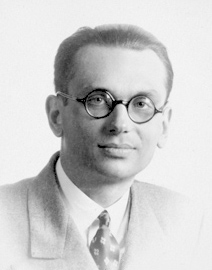
The Logician's Final Theorem
In a quiet Princeton cemetery rests Kurt Gödel, the man whose thinking permanently altered the foundations of mathematics. In 1931, Gödel published his two incompleteness theorems, which demonstrated fundamental limitations to all formal axiomatic systems capable of basic arithmetic. Before Gödel, many mathematicians, led by David Hilbert, sought to build a complete and consistent framework for all of mathematics. Gödel's work showed this goal was impossible.
His first theorem states that within any consistent formal system, there are propositions that are true but cannot be proven within that system. The second theorem follows from the first: such a system cannot prove its own consistency. These conclusions sent a shockwave through the worlds of logic and philosophy, proving that mathematics contains inherent limitations and that truth is broader than provability.
Princeton, Einstein, and Paranoia
Gödel fled Nazi-controlled Austria and arrived in Princeton in 1940, joining the Institute for Advanced Study, where Albert Einstein was also a member. The two became exceptionally close friends, known for their long, daily walks and deep conversations that were a mystery to their colleagues. Einstein once confided that his own work no longer meant much and that he came to the Institute primarily "to have the privilege of walking home with Gödel".
Gödel's later years were marked by intense paranoia and poor mental health. He developed an obsessive fear of being poisoned and would only eat food prepared by his wife, Adele. When she was hospitalized for six months, he refused to eat. Kurt Gödel died on January 14, 1978, from malnutrition and starvation as a result of his persecutory delusions. At the time of his death, he weighed only 65 pounds. His grave is a stone he shares with Adele.